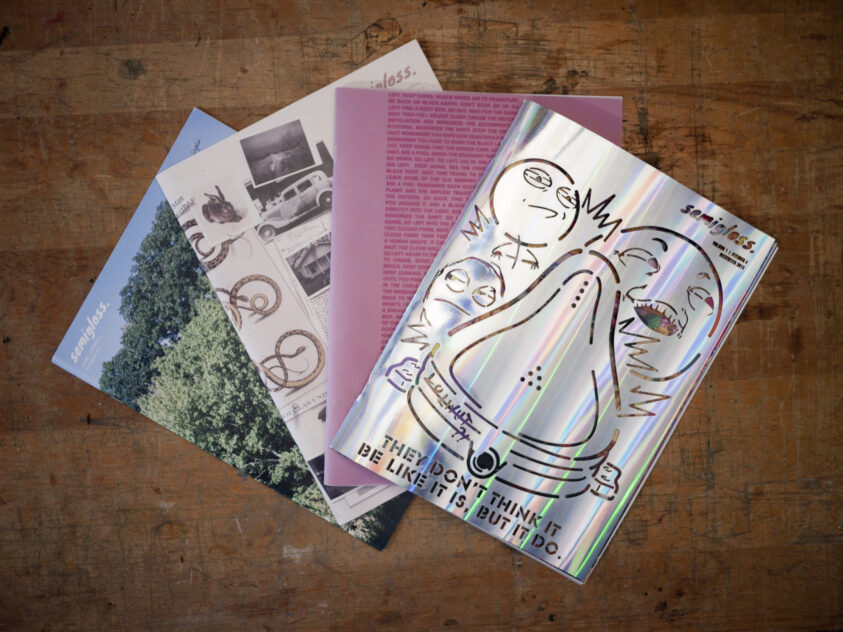
semigloss. Magazine Flip-Through: Issues 1-3
semigloss. Magazine, Volumes I & II
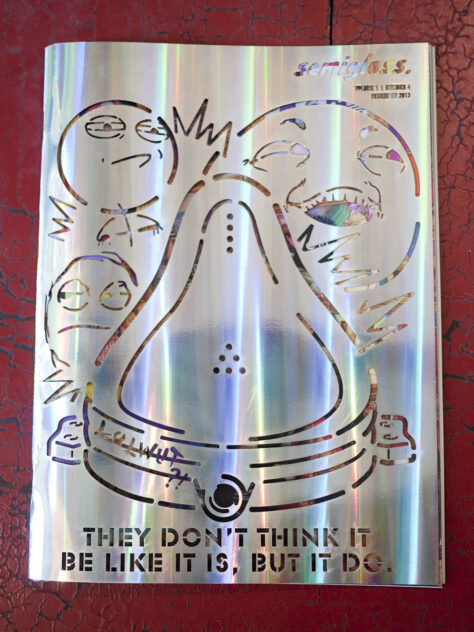
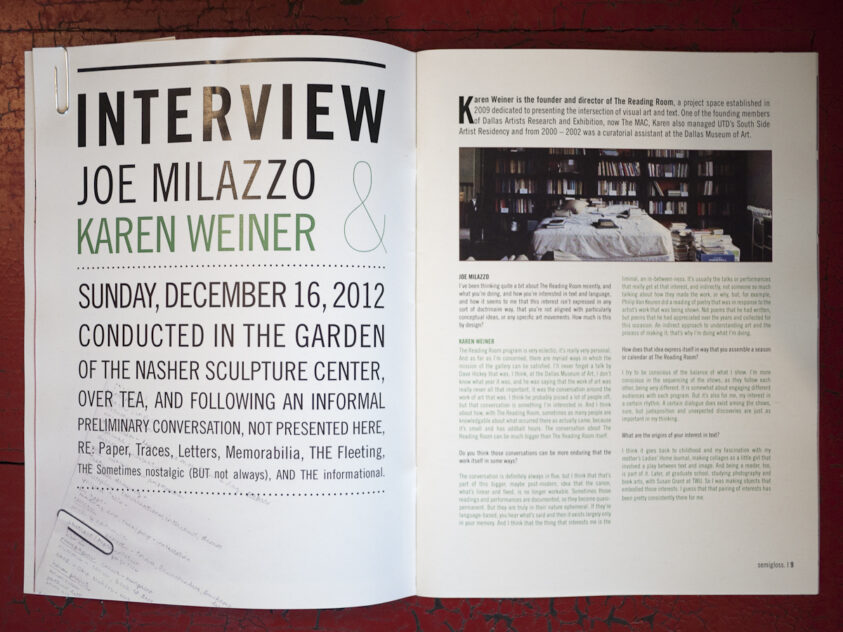
The video above flips through the first three issues of semigloss. Magazine. Each issue was organized around a single theme and built like a group exhibition, with artists and writers responding in images, essays, and objects. Sally Glass served as founding editor-in-chief and Bradly Brown as co-founder and art director.
PLACE — Volume I, Issue I
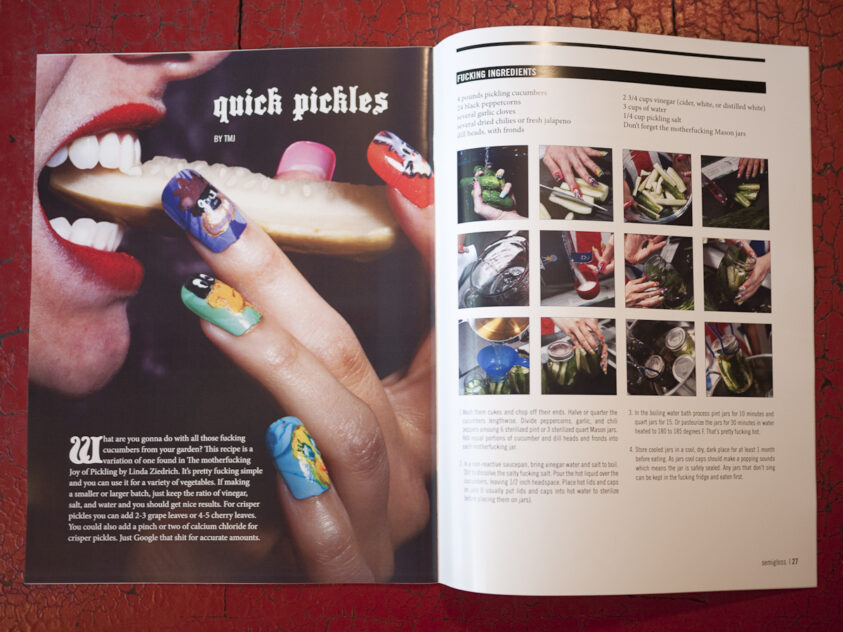
The first issue grew out of remarks made at Radical Regionalism, a panel on North Texas art at CentralTrak. Sally Glass’s welcome note framed the magazine as a series of exhibitions in print, with each contributor interpreting “place” on their own terms, alongside a passage from Richard Long’s “Words After the Fact” (1982). Contributors: Leigh Arnold, Jesse Morgan Barnett, Bradly Brown, Cassandra Emswiler Burd, Michael Mazurek, Adam Neese, Arthur Peña, Gregory Ruppe, Terri Thornton, and TMJ.
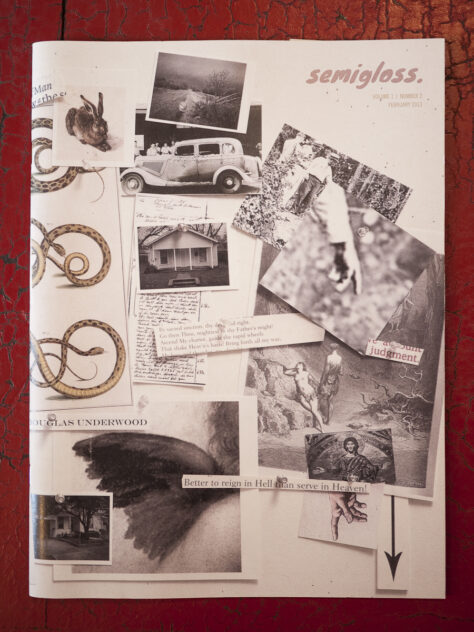
EPHEMERA — Volume I, Issue II
The second issue looked at printed matter and the shift toward screen-based images, opening with Joseph Kosuth’s Second Investigation (1968). Michael A. Morris wrote on cinema’s move from analog to digital, R.CF built a visual narrative from yourworldoftext.com, Kevin Todora asked children to draw the dictionary definition of “ephemera,” and Sally Glass revisited Dan Graham’s Homes for America (Arts Magazine, 1966). Contributors: Bradly Brown, Matt Cusick, Danielle Georgiou, Eric Harvey, Stephen Lapthisophon, Joe Milazzo, Michael A. Morris, R.CF, Gregory Ruppe, Ariel Saldivar, Kevin Todora, and Andrew Douglas Underwood.
FAILURE — Volume I, Issue III
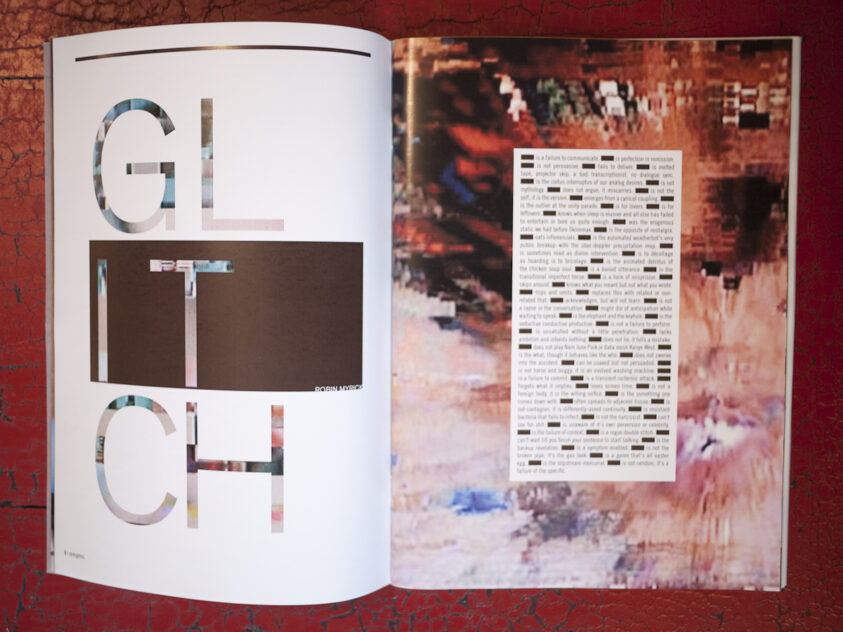
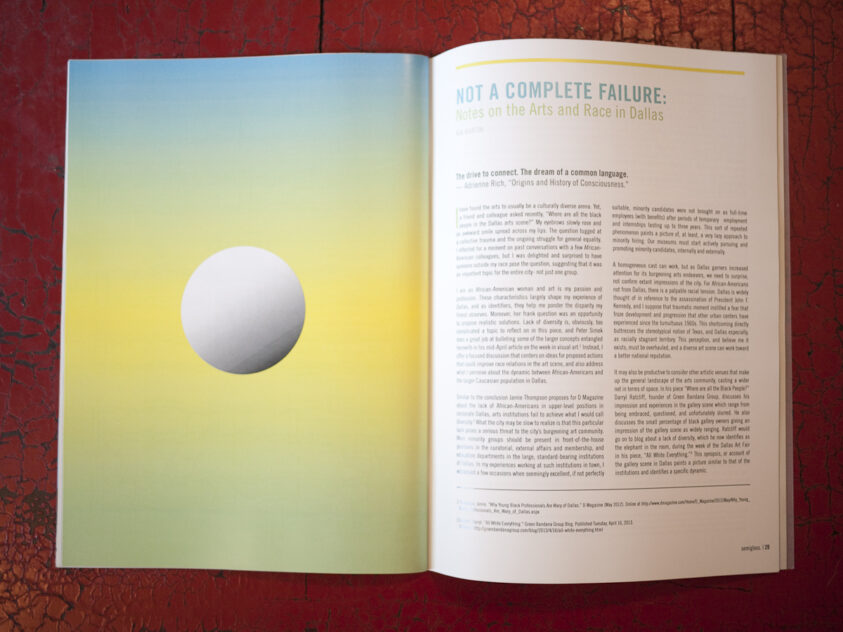
The third issue opened with John Baldessari’s WRONG and the anxiety of trying to make “successful” art. It included Margaret Meehan’s painted portrait of Julia Pastrana based on a tintype, and Lucia Simek’s Untended (after Rilke), burnt text pages in vinyl sleeves, also produced as a limited-edition sculptural piece. Contributors: Kristen Cochran, Ryan Goolsby, Aja Martin, Margaret Meehan, Robin Myrick, Kris Pierce, Christina Rees, Ryder Richards, Gregory Ruppe, Ludwig Schwarz, Marjorie Schwarz, Noah Simblist, Lucia Simek, Bruce Lee Webb, and Jeff Zilm.
FUTURE — Volume I, Issue IV
Published in 2013, the fourth issue considered the future in relation to time, technology, relationships, and the body, with an editorial built around a quote from Ted Nelson. Brad Troemel contributed collages made from found images, Kim Asendorf and Alfredo Salazar-Caro made an augmented-reality self-portrait from personalized Facebook ads, and Noah Simblist interviewed A.L. Steiner and A.K. Burns about their film Community Action Center. Contributors: Morehshin Allahyari, Kim Asendorf, Jesse Morgan Barnett, Mary Walling Blackburn, Christopher Blay, Bradly Brown, Debora Delmar Corp., Jeff Gibbons, Guthmiller Randy, Blake Hestir, Kevin Rubén Jacobs, Travis LaMothe, Michael Mazurek, Shelby David Meier, Randell Morgan, Devon Nowlin, Arthur Peña, Kris Pierce, Alfredo Salazar-Caro, Noah Simblist, and Brad Troemel.
DB14 — Volume II, Issue I
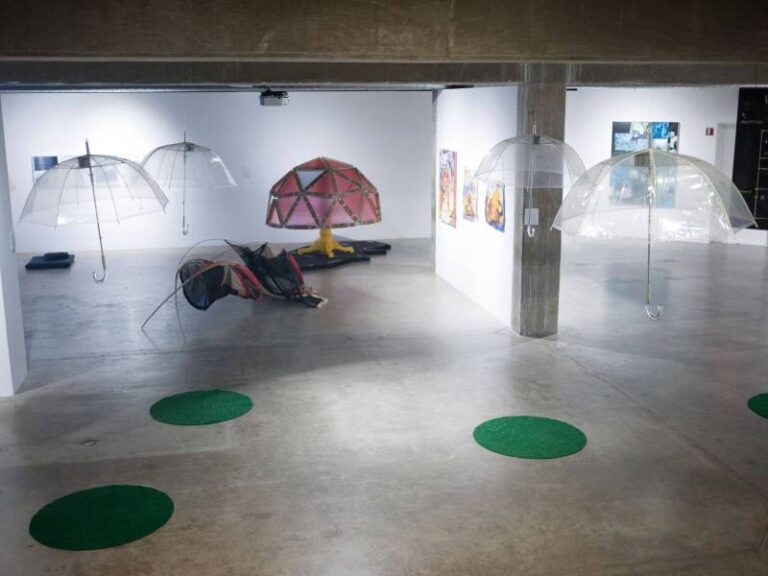
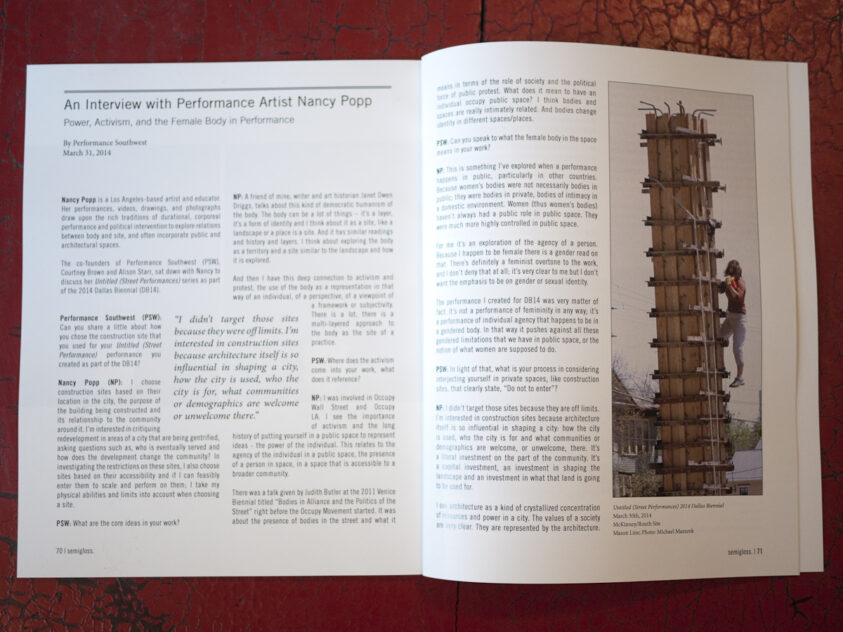
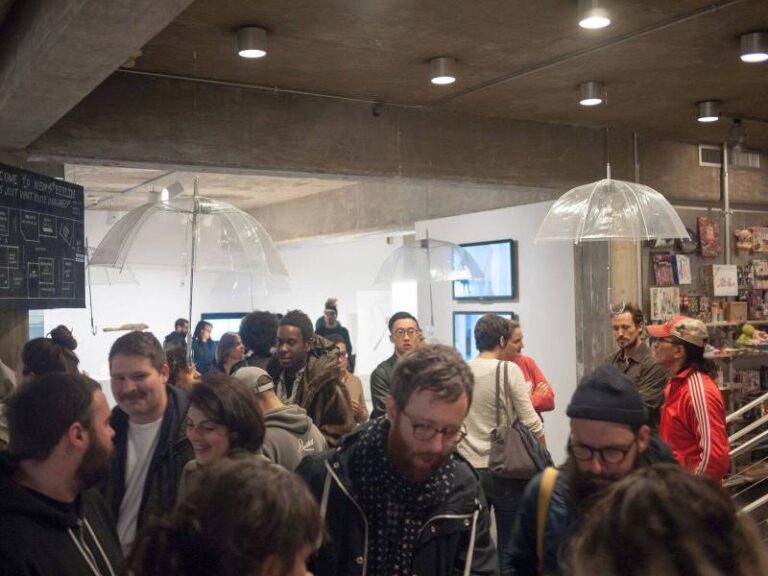
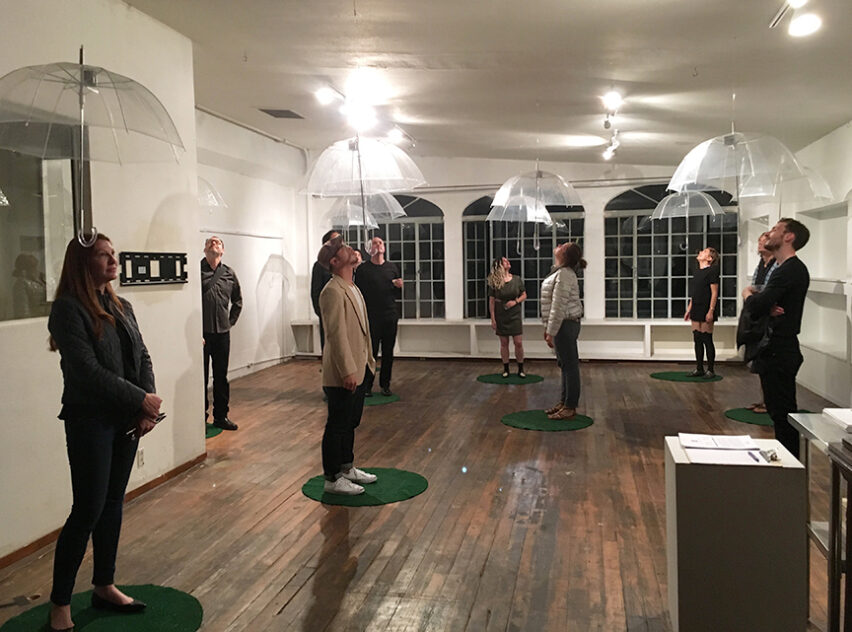
The fifth issue was a collaboration with the 2014 Dallas Biennial, founded in 2011 by Jesse Morgan Barnett and Michael Mazurek. semigloss. acted as host and partner in dialogue for a run of exhibitions across Dallas–Fort Worth over several months. The issue included black-and-white photographic manipulations by Asger Carlsen and Devin King’s essay “To Be Loved,” on Shakespeare’s All’s Well That Ends Well. Contributors: Conrad Atkinson, Courtney Brown, Asger Carlsen, Alterazioni Video, Geraldine Gliubislavich, George Horner, Devin King, Stephen Lapthisophon, Tom Lawson, Kate Mayne, Meet the Schwarzes, Tucker Meyers, Lana Paninchul, Adrian Piper, Nancy Popp, Michelle Rawlings, Veritas Rechtschreiber, Richard Roth, Alison Starr, and Michael Vorfeld.
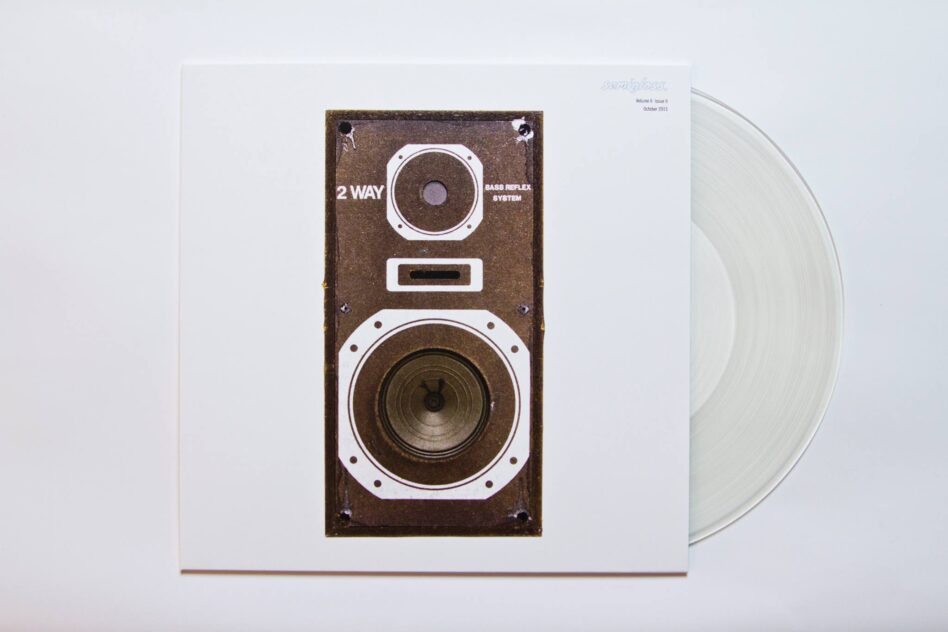
The sixth and final issue, SOUND, was released as a vinyl record in 2016.