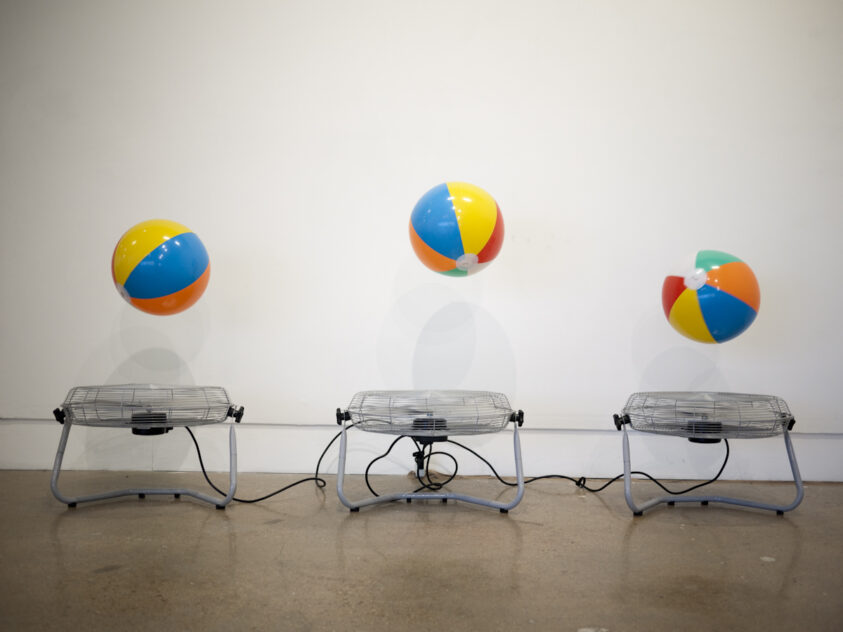
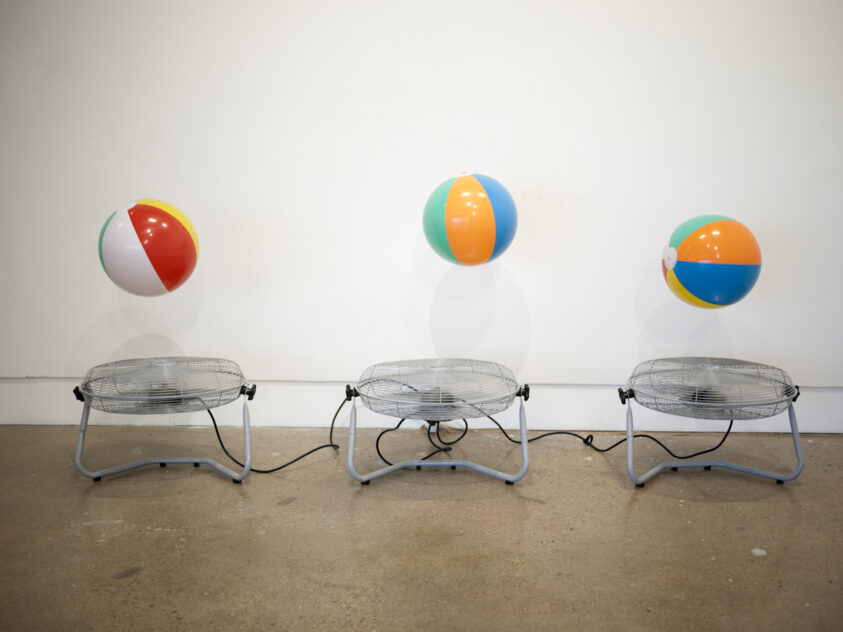
Attention Retention, 2012
Three floor fans and three 16″ beach balls
Exhibited in For a Limited Time Only, Brown’s TCU MFA thesis exhibition, Fort Worth Contemporary Arts, Fort Worth, TX, 2013. Named one of the Top Five Artworks in Fort Worth Weekly’s Best of Culture 2013.
Walking through Walmart one day, Brown saw about six people gathered around a product display. Under a sign reading “Clearance—High Velocity Floor Fans—$34,” a chrome fan pointed straight up on full blast, with a multicolored beach ball hovering in the air above it. Bernoulli’s principle keeps the ball in place: fast-moving air has lower pressure than still air, so the stream wraps around the ball, pushes it back to center whenever it drifts, and holds it aloft. It’s a trick many people remember from junior high physics or a children’s science museum.
What caught Brown’s attention wasn’t the trick but the shoppers, who stood transfixed. The display held people longer than most viewers spend with an artwork in a museum or gallery. Would the same device hold an audience the same way if it were presented as an art object? Could it work as a Duchampian readymade once it was moved into a gallery?
Attention Retention takes that question into the gallery as a kind of social experiment. Three floor fans sit in a row, each levitating a 16″ beach ball. The balls bob in a constant rhythm, filling the room with color and repetitive motion that is hypnotic, holding the viewer’s gaze while demanding attention.
In a world of media saturation and nonstop information, attention has become a sought-after commodity. One 2008 study found that the average attention span had dropped to five minutes, down from twelve a decade earlier. Placed in a gallery, the piece becomes a constant distraction that changes how the whole space is experienced. A moving object in a still room is a kind of seduction: even viewers who aren’t looking at it keep it in their peripheral vision or steal quick glances. That pull is a survival instinct. The brain reads movement in a quiet space as one of three things: a predator, a source of food, or a potential mate.
The repetitive bobbing also gives the beach balls a kind of personality, and viewers begin to relate to them as if they were alive. Attention Retention was part of For a Limited Time Only, Brown’s 2013 MFA thesis exhibition at TCU, which looked at how attention, behavior modification and the drive to survive shape everyday decisions. See also Escape Plan and Purification Station, which were shown in the same exhibition.