Dearman, 2026

Dearman, 2026
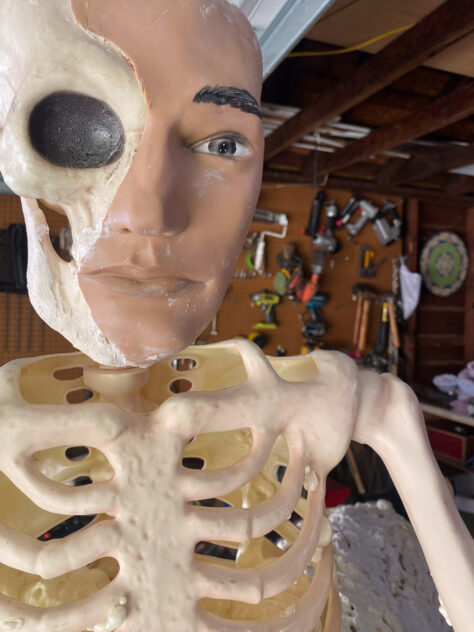
Mixed media: found objects, foam, plaster, and paint
Approx. 75″ × 50″ × 30″, dimensions variable

Exhibited in YARD, an exhibition series in Houston front yards organized by Chris Wicker, Anna Taylor, and Trent Teinert with support from The Idea Fund

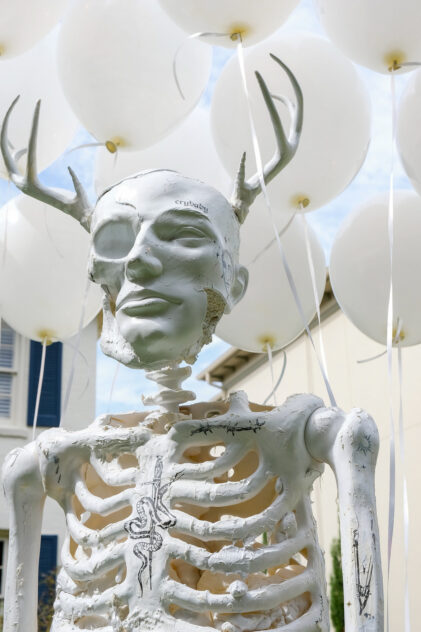
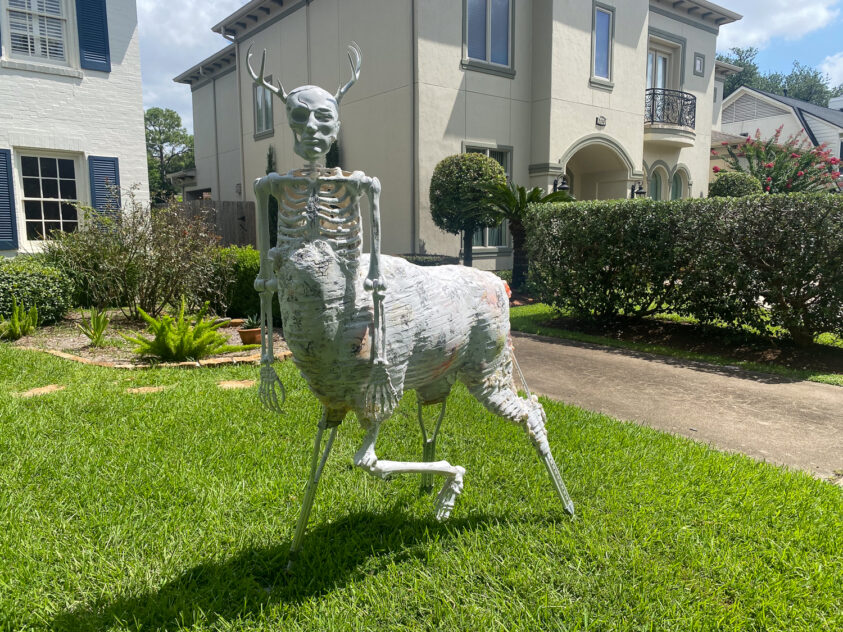
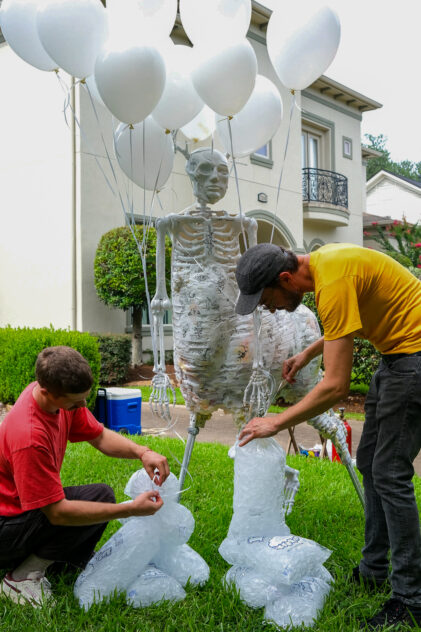
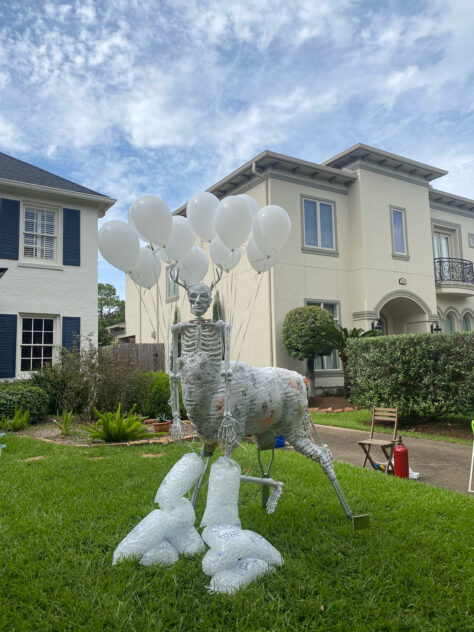
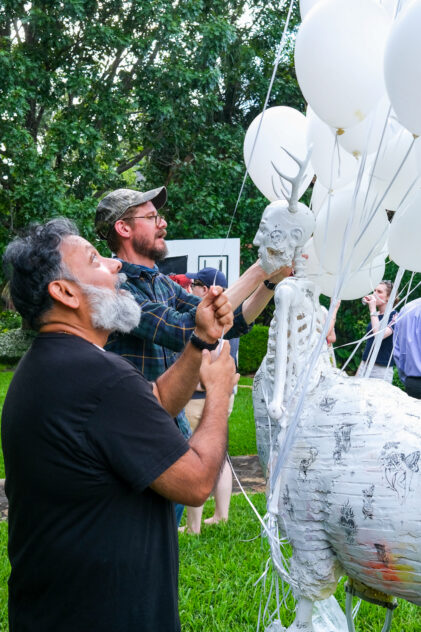
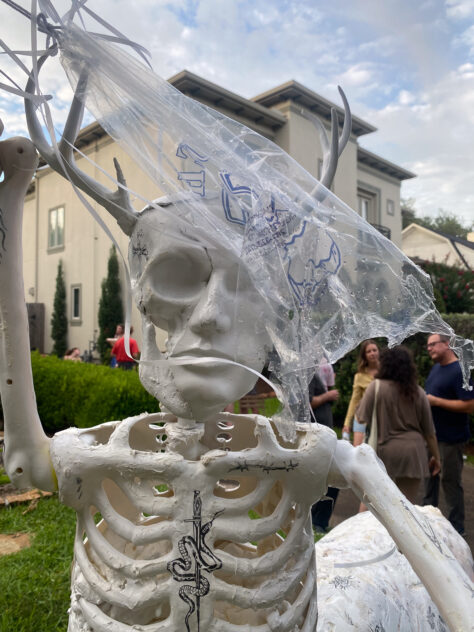
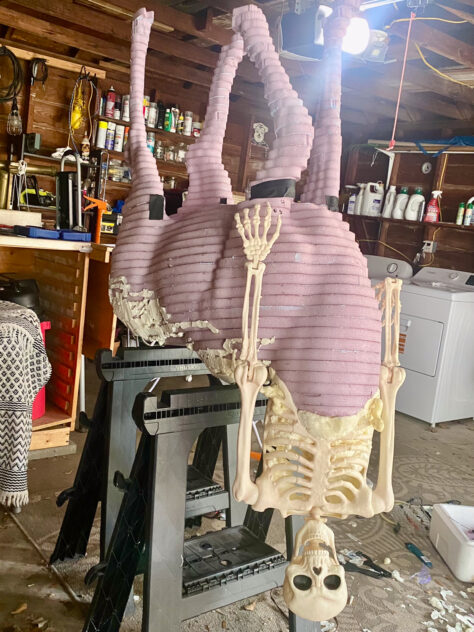
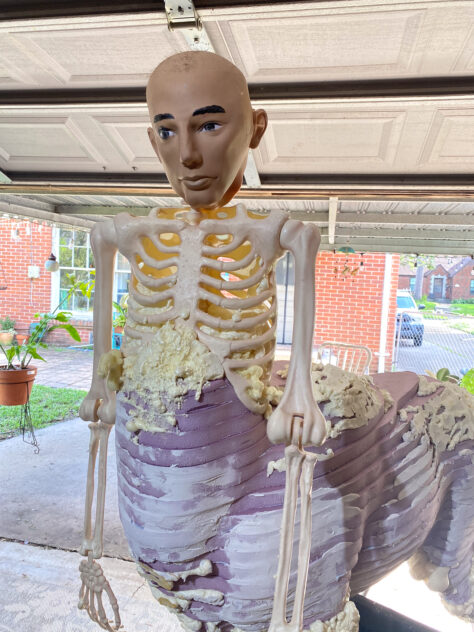
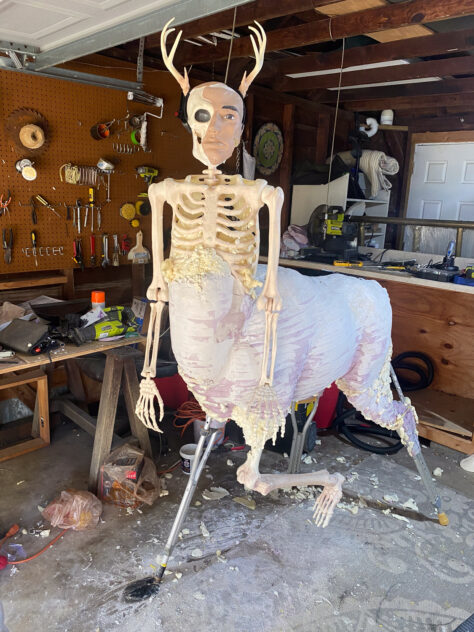
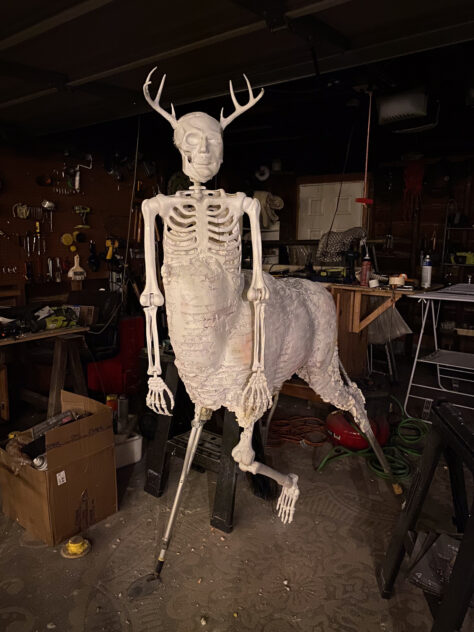
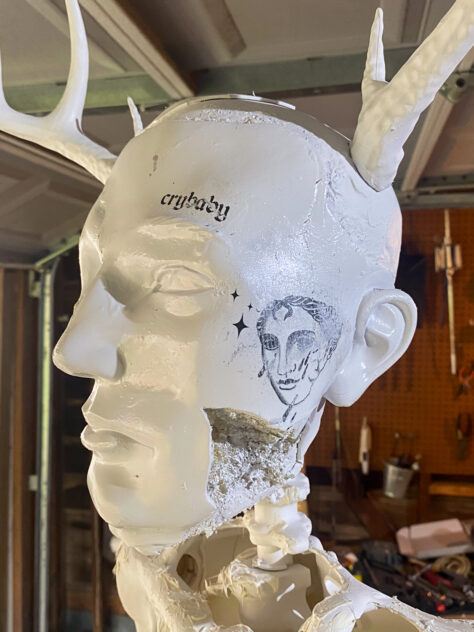
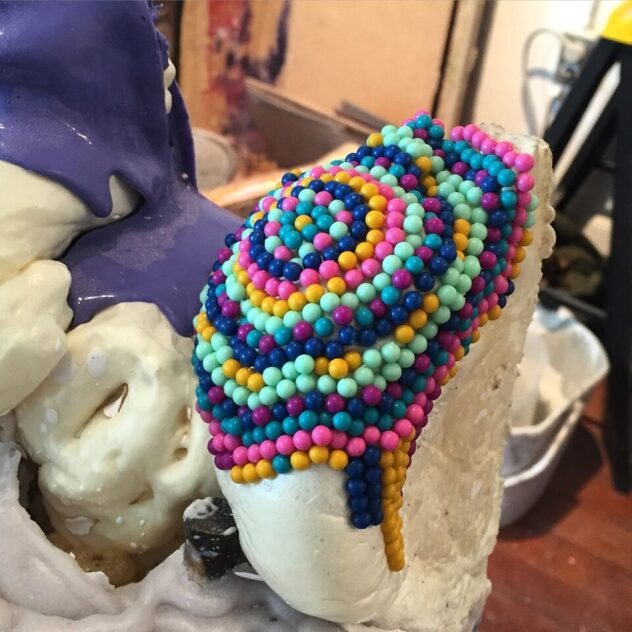
Dearman is a cervitaur, a half-man, half-deer figure built from found objects, foam, plaster, and paint. Its name and structure come from DEAR MAN, a skill from Dialectical Behavior Therapy for asking clearly for what you need.
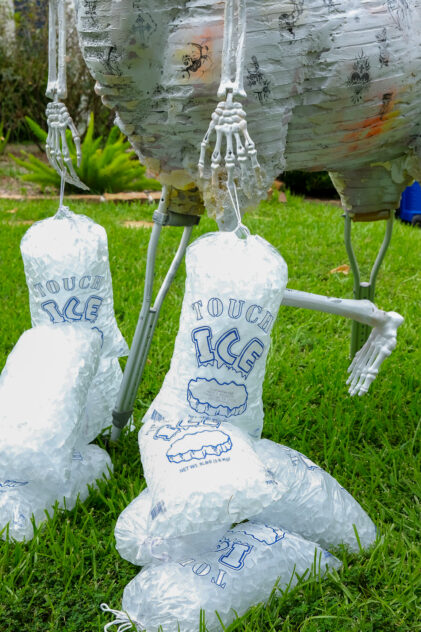
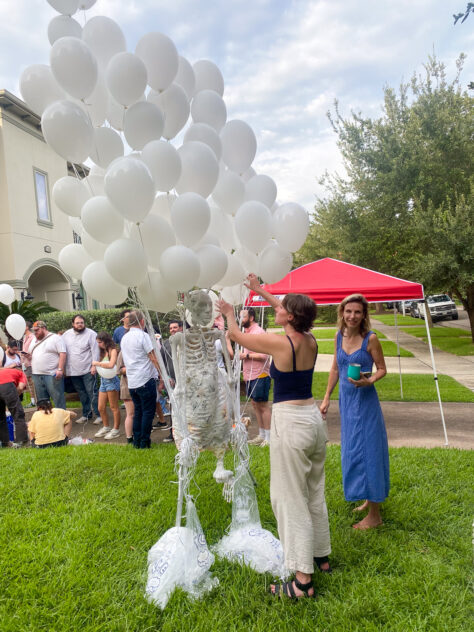
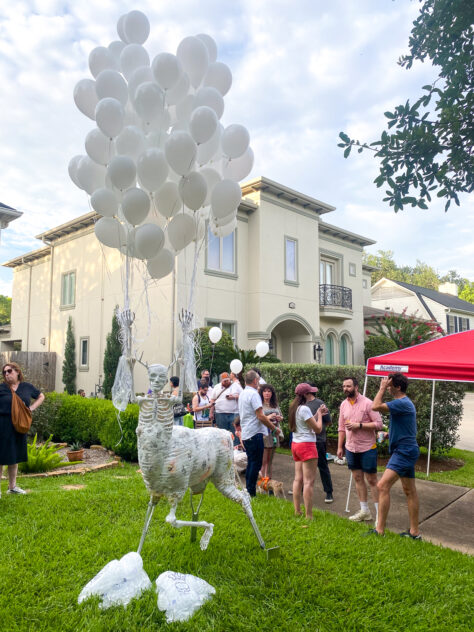
Presented in a front yard, Dearman stood with ten bags of ice tied to his wrists, five in each hand, weighing his arms down. Throughout the exhibition, visitors were invited to fill a helium balloon and tie it to his wrist. Over three to four hours, the Houston heat melted the ice, the balloons accumulated, and, with a final push from a gust of wind, both of his arms rose straight into the air.
The work depended on weather, time, and the people who wandered through the yard to complete it. In a gallery it would have been a sculpture with a set of instructions; in the open it became a slow public event. The final pose can be read as surrender, hands up, or as ascension, asking to be lifted.

Layer Cake, 2024

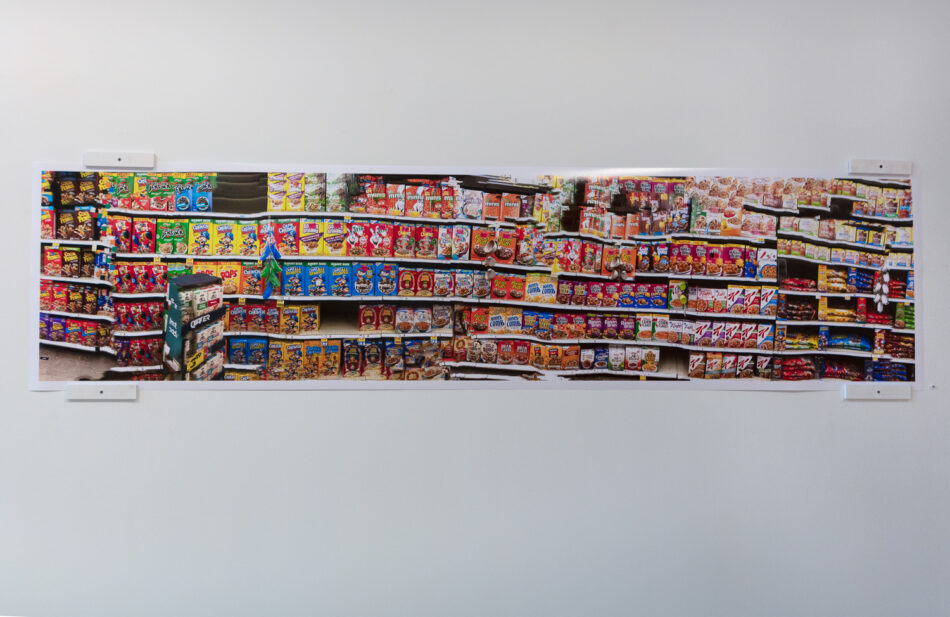
Layer Cake (San Miguel, Valmontone, & Cereal Aisle), 2024
Inkjet prints
24″ × 95″ each

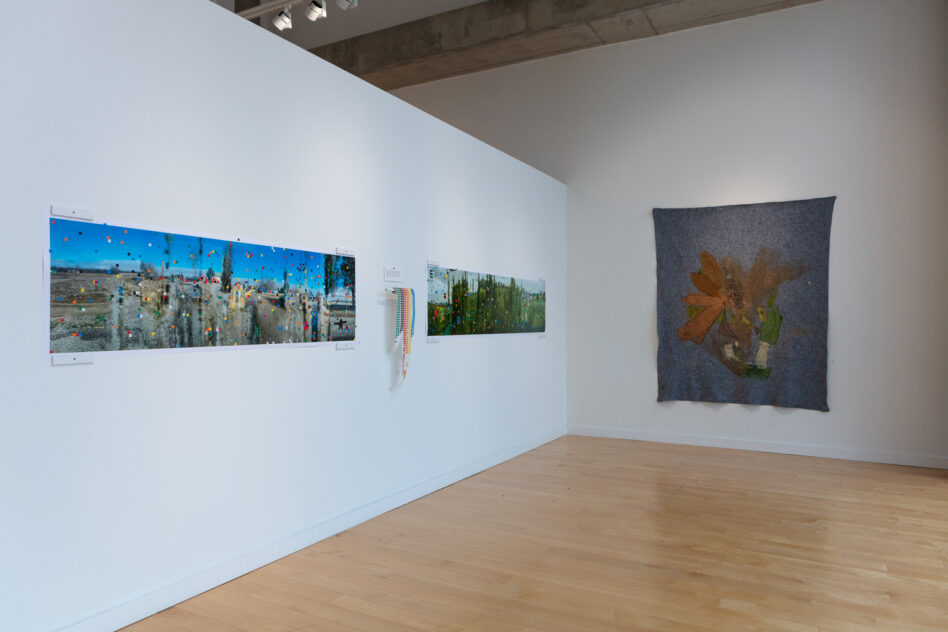
Exhibited in Layer Cake, a group exhibition with Jonathan Paul Jackson and Xochi Solis at the University Gallery, Sam Houston State University, Huntsville, Texas.
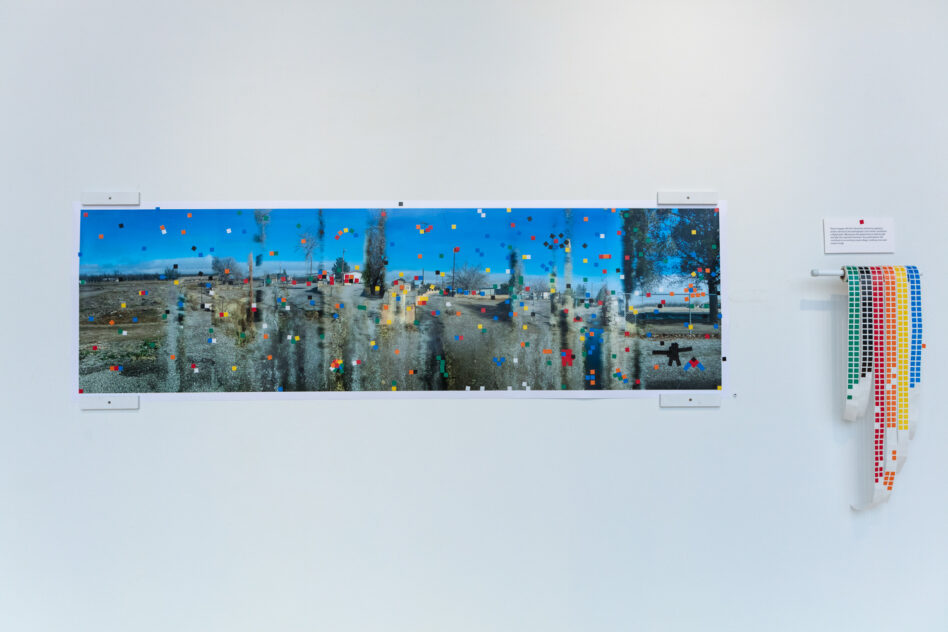
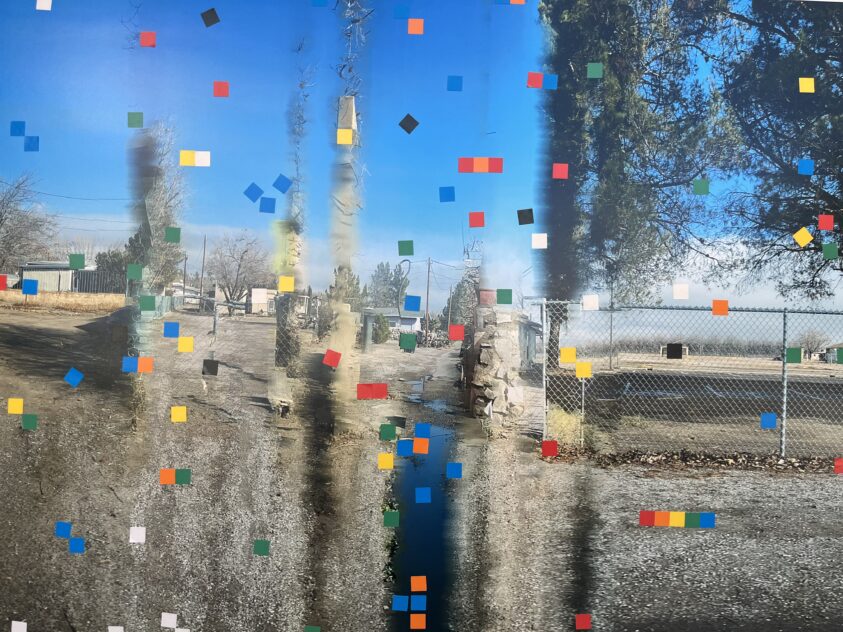
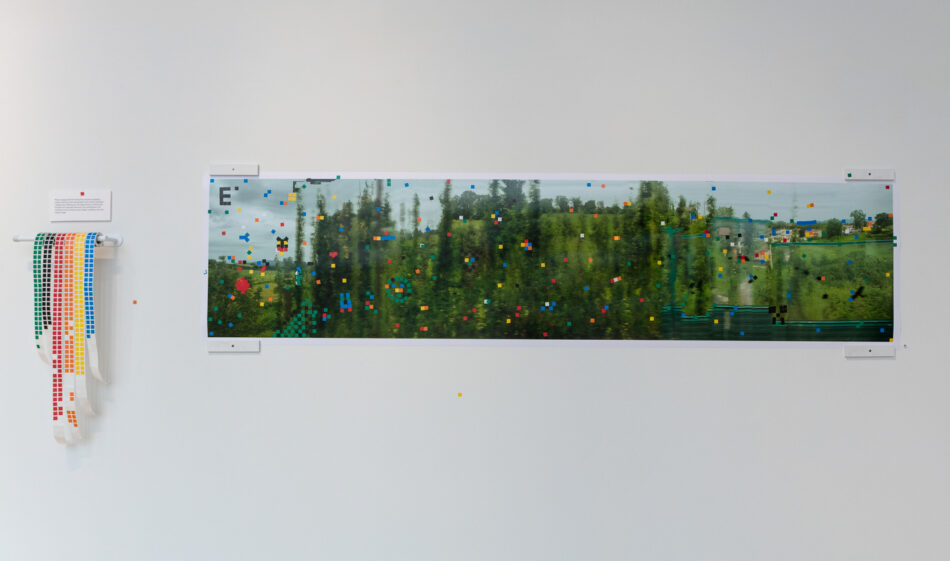
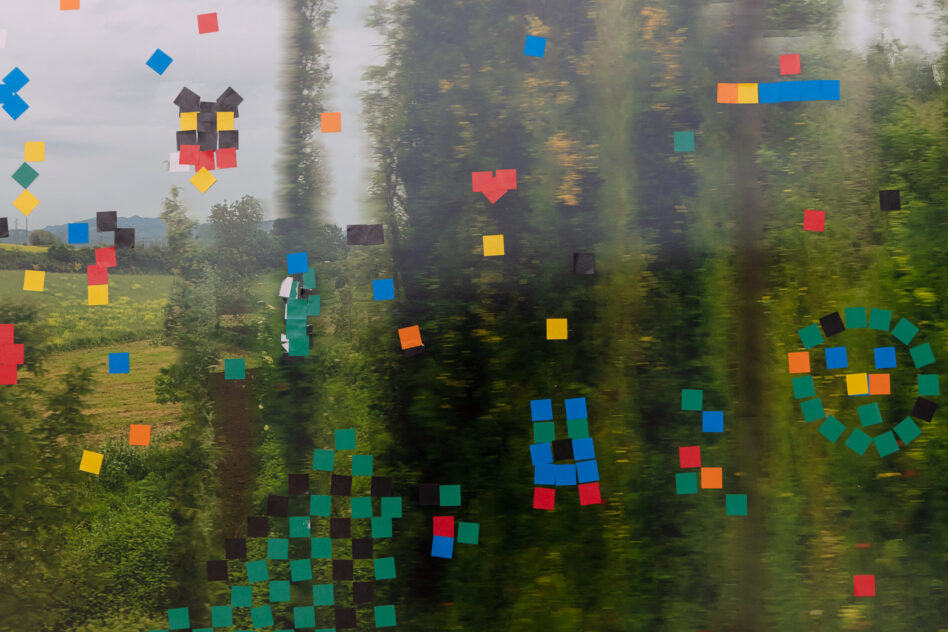
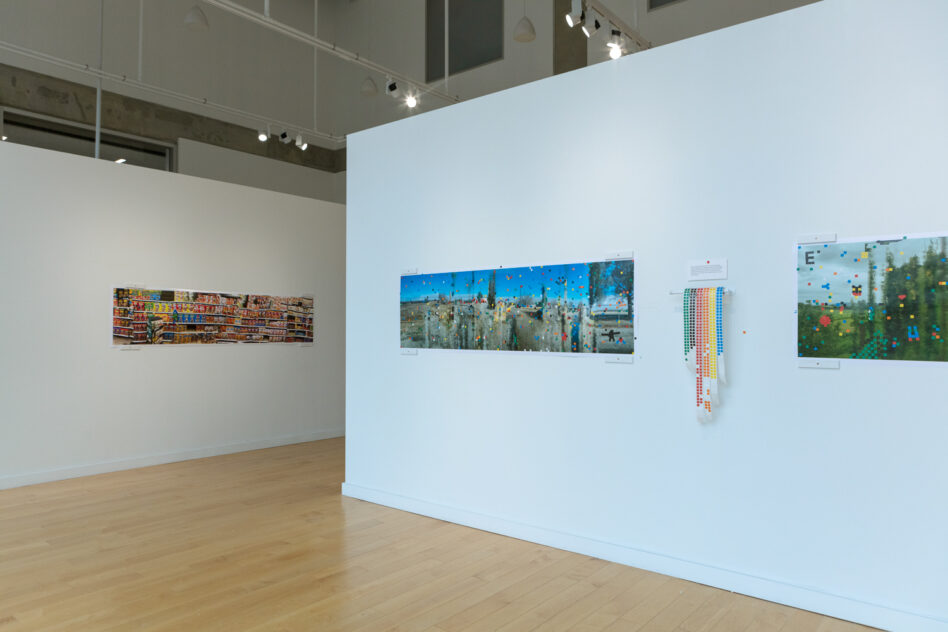
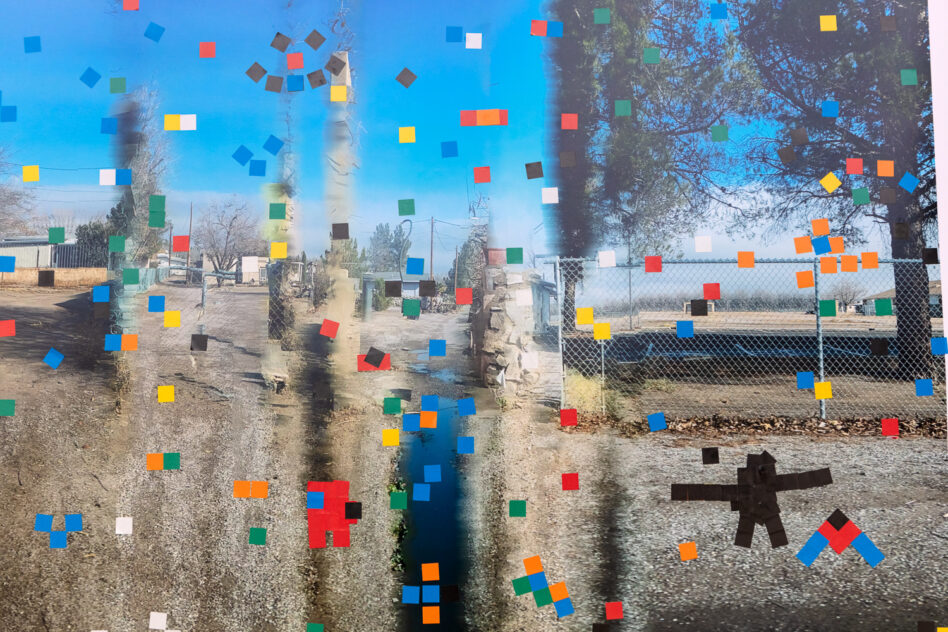
Each panorama in Layer Cake was shot on an iPhone from a moving vehicle: a train, a car, or a shopping cart. Panorama mode expects a slow, steady sweep, so the motion breaks each scene into stretched, repeated, and misaligned slices full of digital glitches and distortion.

In the gallery, the prints hang alongside spools of tiny square stickers in red, green, blue, black, and white. Each sticker is a pixel. Visitors are invited to patch and repair the glitches, but every repair adds to the abstraction, turning the camera’s errors into a shared composition.

Each person becomes a pixel, and the image reaches its best resolution only when everyone takes part.

UUUUUU, 2023

UUUUUU (The Last Laugh), 2023
Copper wire from internet cable
Dimensions variable

Exhibited in SPHERE Salón Internacional de Arte Contemporáneo, Mexico City, Mexico, 2023, and 150 Years 150 Artists, Fort Worth Contemporary Arts, Fort Worth, TX, 2023.

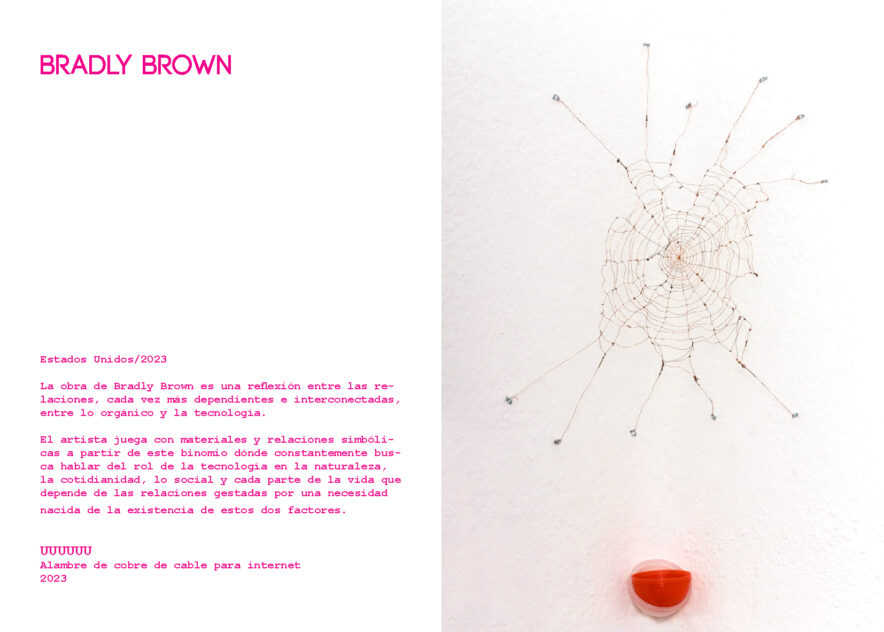
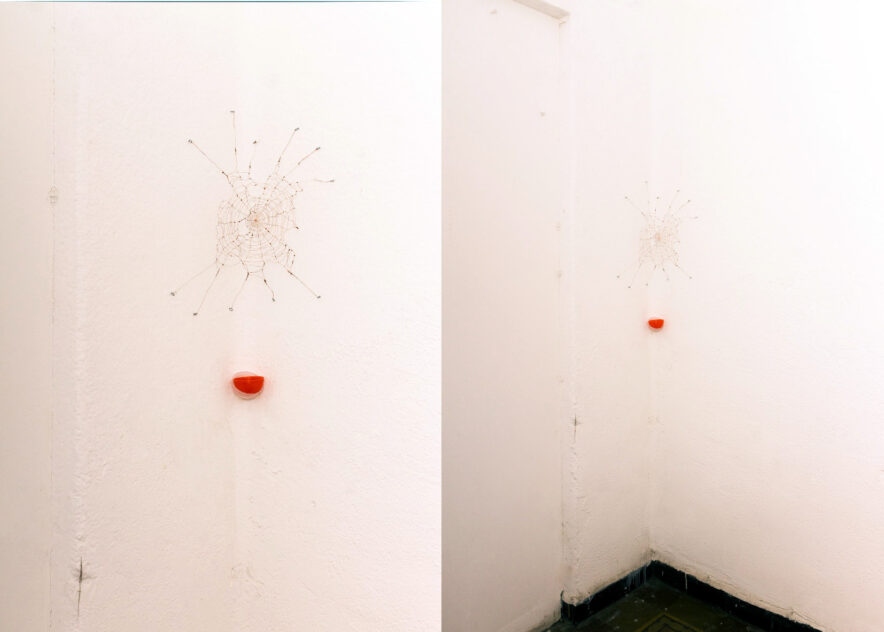
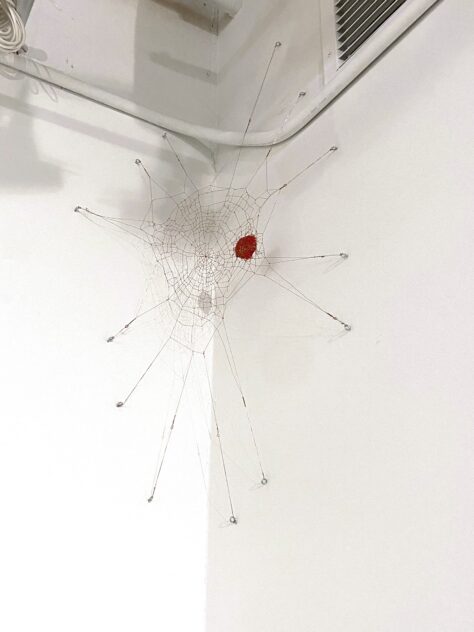
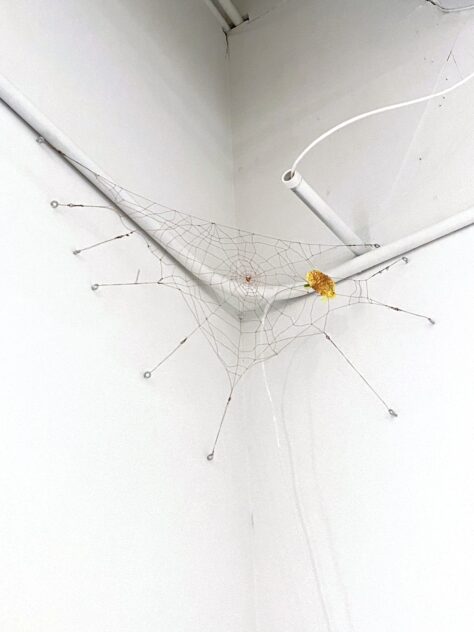
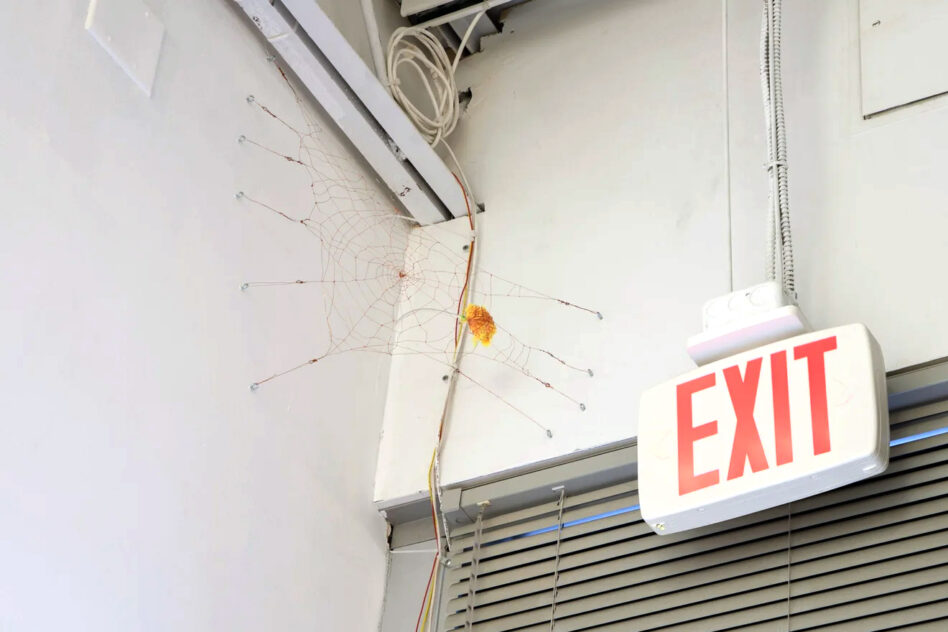
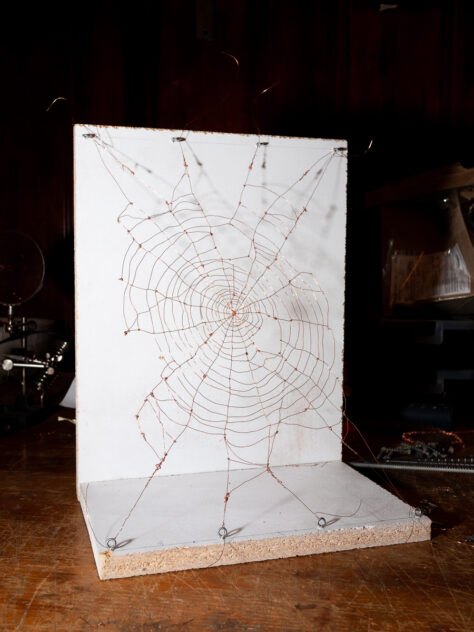
UUUUUU explores the increasingly dependent, interconnected relationship between the organic and the technological. Using copper wire stripped from internet cable, Brown hand-forms a spiderweb, a structure that is both a natural network and a stand-in for the digital one the material was built to carry.

The series title is a play on “WWW,” the World Wide Web. Works subtitled The Last Laugh hold a clown accessory caught in the web: a red clown nose, or a gag flower that squirts water.

The work is part of an ongoing practice that plays with materials and their symbolic associations to consider technology’s role in nature, daily life, and social connection, and how much of contemporary life now depends on the bond between the two.

Numbers 23:23, 2018

Numbers 23:23 (What hath God wrought!), 2018
Solar Studios at Rice University, Houston Tx

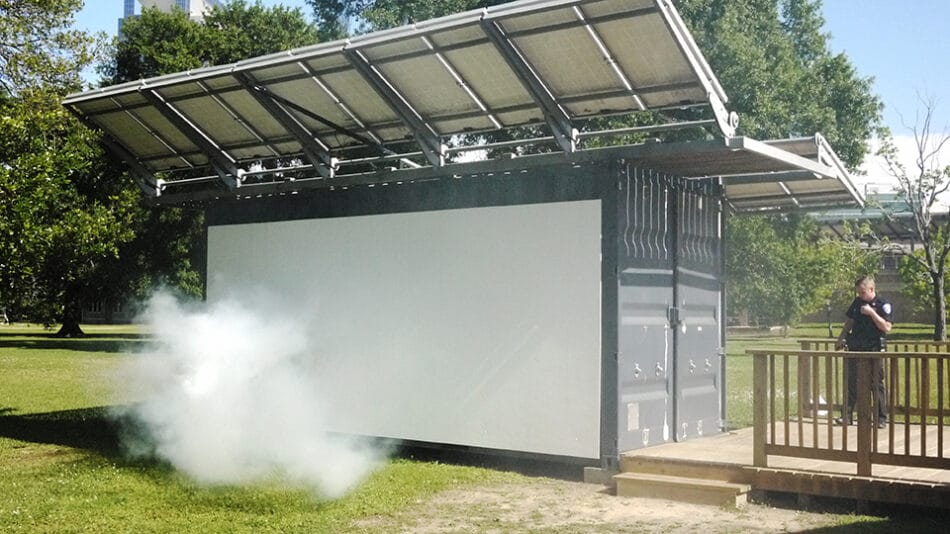
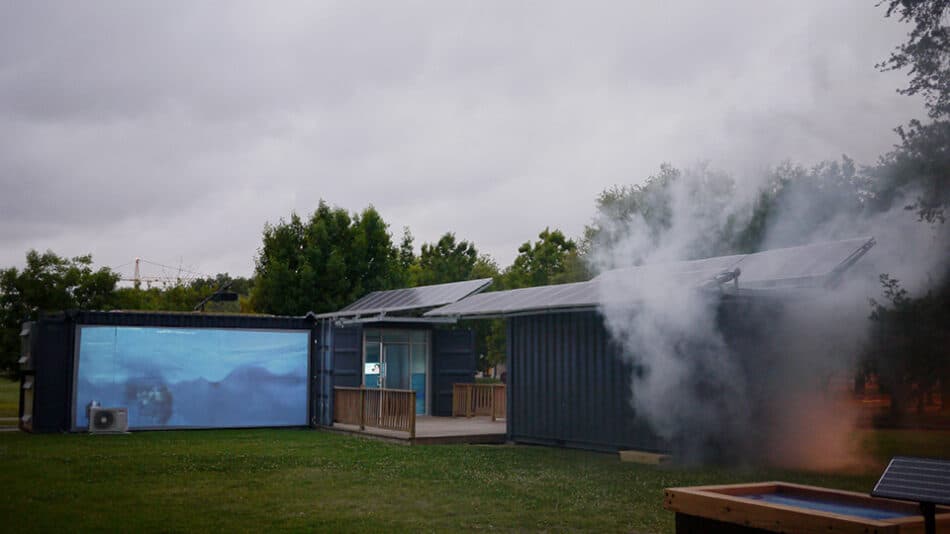
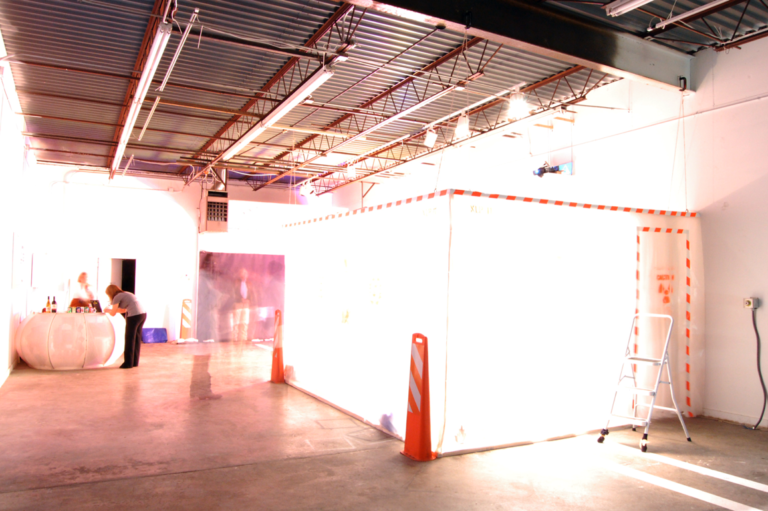
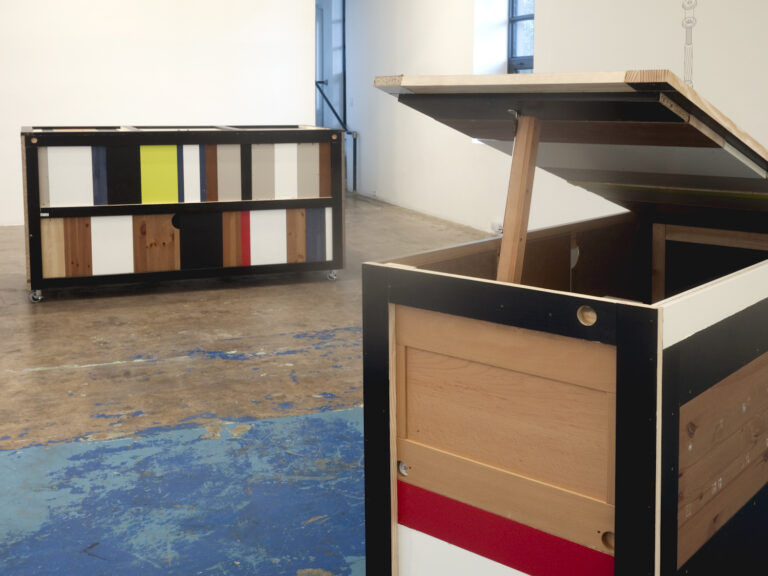
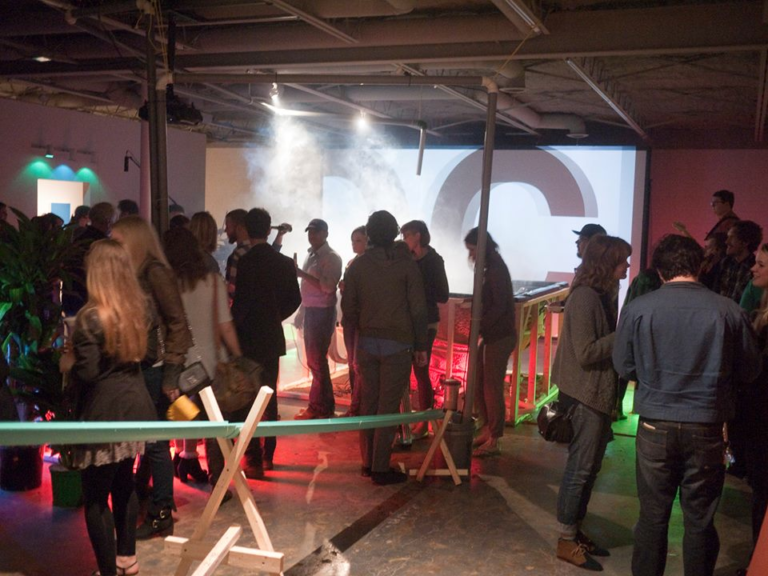
Created for The Ends of Our Index Fingers Are Mute at the Solar Studios, Numbers 23:23 (What hath God wrought!) turned the exhibition space into the sculpture. Each artist in the exhibition was given a container as a place to present work, instead of filling the space, Brown sealed it shut with a chain and padlock, closing off the interior and leaving visitors on the outside.

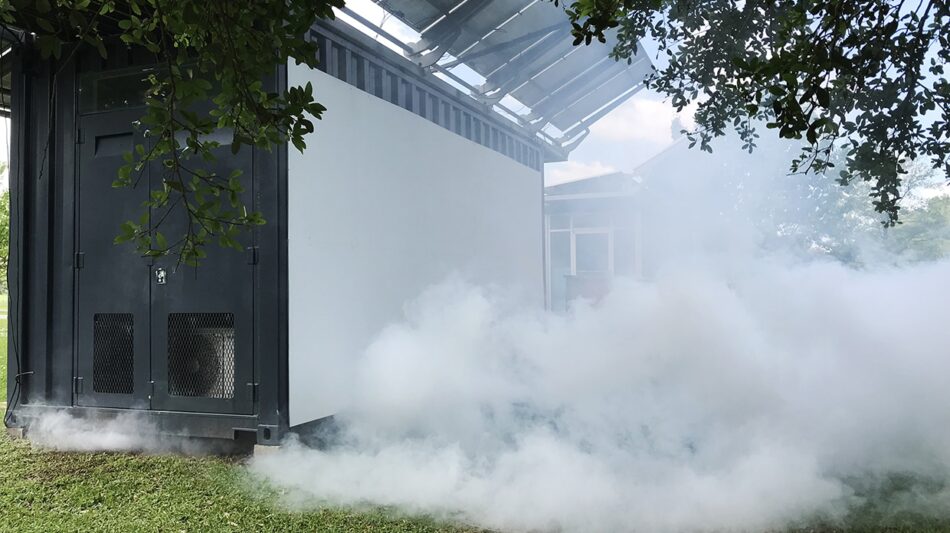
Inside, a smoke machine controlled by a programmable timer switches on and off in the rhythm of Morse code. The pattern spells out “What hath God wrought,” the message Samuel F. B. Morse sent in 1844 to open the American telegraph era. The phrase comes from the Book of Numbers, chapter 23, verse 23. As smoke fills the container, it seeps through the seams and gaps and rises into the air, so the sealed box appears to be sending a signal in the middle of the Rice University campus.

The piece drew the attention of many passersby who didn’t know it was an artwork. Over the course of the exhibition, police and the fire department were called to the site several times.

The work reflects on the unintended consequences of our efforts to solve problems. Powered by the sun and staged within a solar-energy research space, the container points to our search for clean, renewable energy, and to the way each fix tends to create a new problem. When we put out one fire, we often start another. Morse’s message, first sent as a marvel of human progress, becomes a question about what our inventions set in motion.

.– …. .- – / …. .- – …. / –. — -.. / .– .-. — ..- –. …. –

Failure to Launch, 2016

Failure to Launch (excerpt), 2016
Single-channel video
(01:41:18)

Exhibited in how2magpie, Lawndale Art Center, Houston, TX, 2016

Filmed at Challenger Seven Memorial Park in Houston, Failure to Launch follows a bag of ice tied to seven helium balloons. The plan was simple: as the ice melted, the bag would become light enough for the balloons to lift it off the ground and carry it into the sky. That never happened.

Instead of rising, the bag was pushed by the wind into the grass, where the balloons popped one by one. In a park dedicated to the seven astronauts lost aboard the Space Shuttle Challenger, the result carries a dark poignancy the original plan never could have. The title is an honest account: not what was planned, but what happened.

Shown in full on a vertical monitor, the video runs more than an hour and a half and offers no promise of a payoff. Viewers decide for themselves how long to wait for a takeoff the title suggests may never come.

Press:
“Escaping the Narrative Trap of Video Art: David Politzer and Bradly Brown”,
Brandon Zech, Glasstire, May 21, 2016

Failure to Launch (excerpt) from Bradly Brown on Vimeo.

Several Ways to Start a Fire, 2013

Several Ways to Start a Fire, 2013
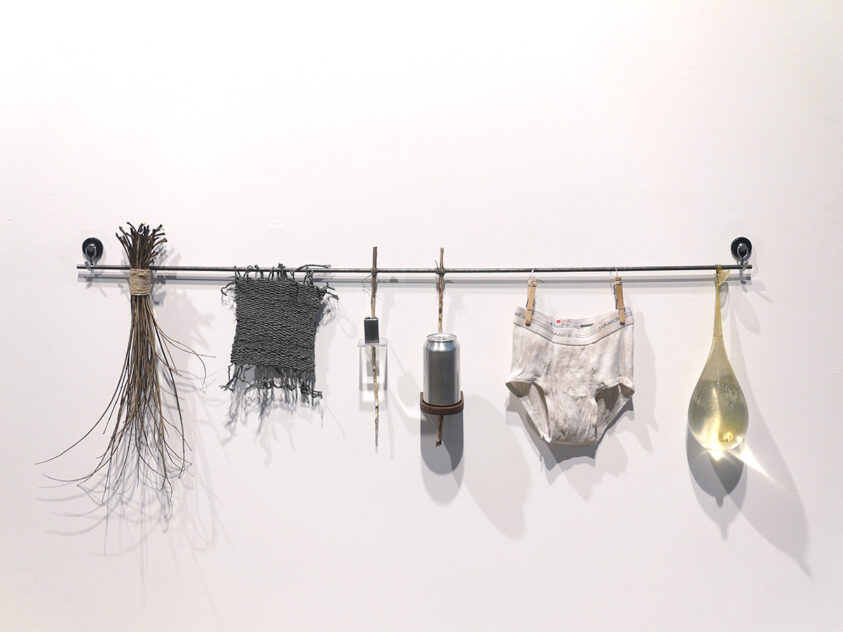
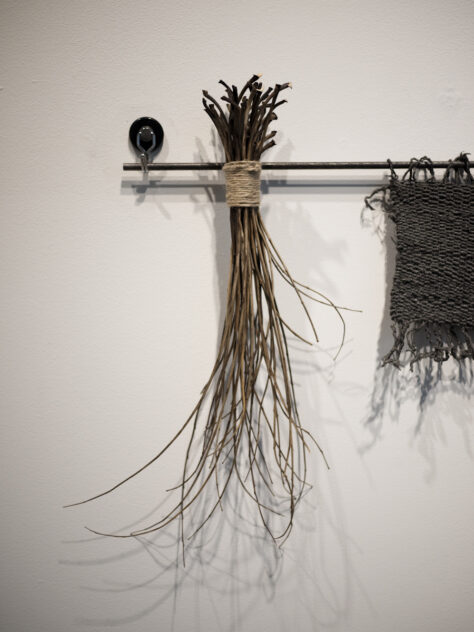
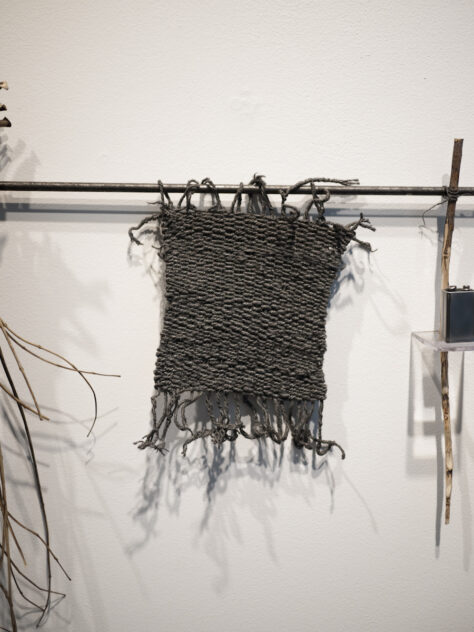
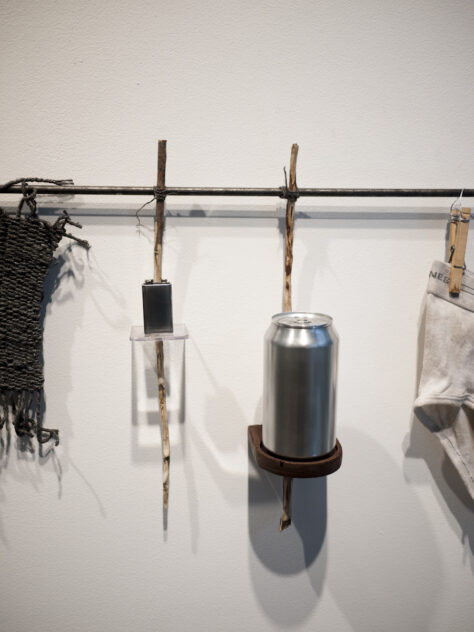
Twigs, rope, steel wool, 9v battery, magnifying glass, aluminum can, chocolate, underwear, close pins, condom, water, and hardware

Exhibited in For a Limited Time Only, MFA thesis exhibition, Moudy Gallery, Fort Worth, TX, 2013

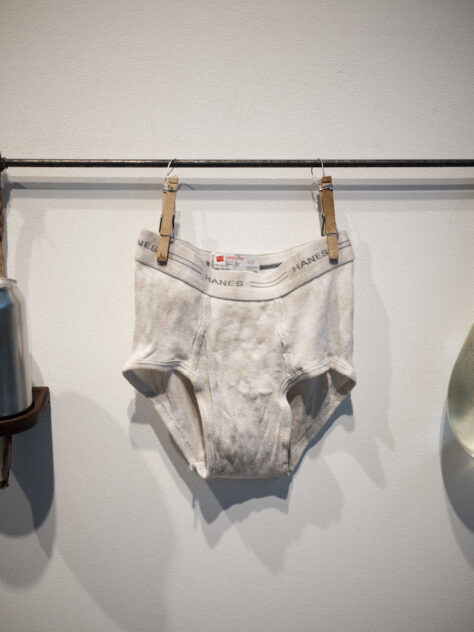
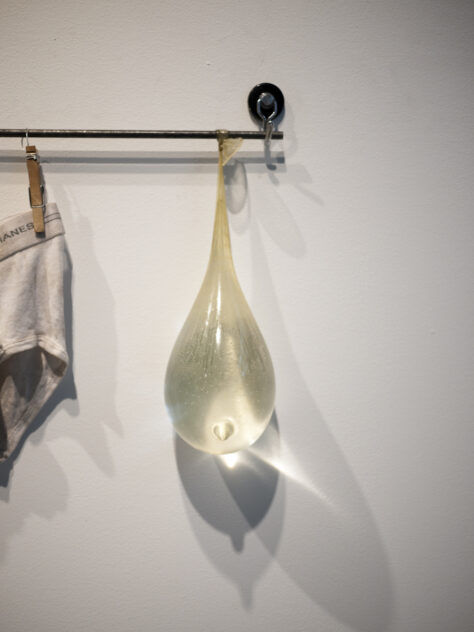
Control of fire is one of the turning points of human evolution. It kept predators away, stretched the day past sunset, drew people together, and cooked the food that fed bigger brains. Several Ways to Start a Fire gathers the materials survivalists use to make fire: twigs, rope, steel wool, a 9-volt battery, a magnifying glass, an aluminum can, chocolate, cotton underwear, clothespins, and a water-filled condom.

Each object has been altered to pull it further from its everyday use, and the arrangement reads first as a formal composition. The piece works two ways: as an art object while there is a market to value it, and as a working survival kit if that market ever collapses. Making fire is part of what makes us human, and so is making, and admiring, things that have no practical use.

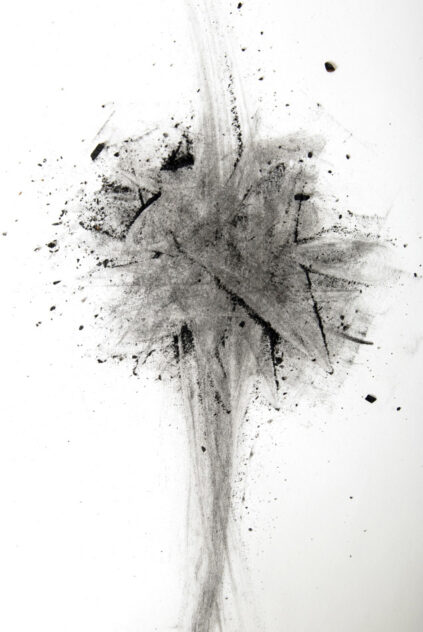
Brown also explores fire as a creative material in his earlier series Matchbooks, where burned matches are crushed into ash and then dragged across paper like charcoal, tracing the path from raw material to the act of drawing.

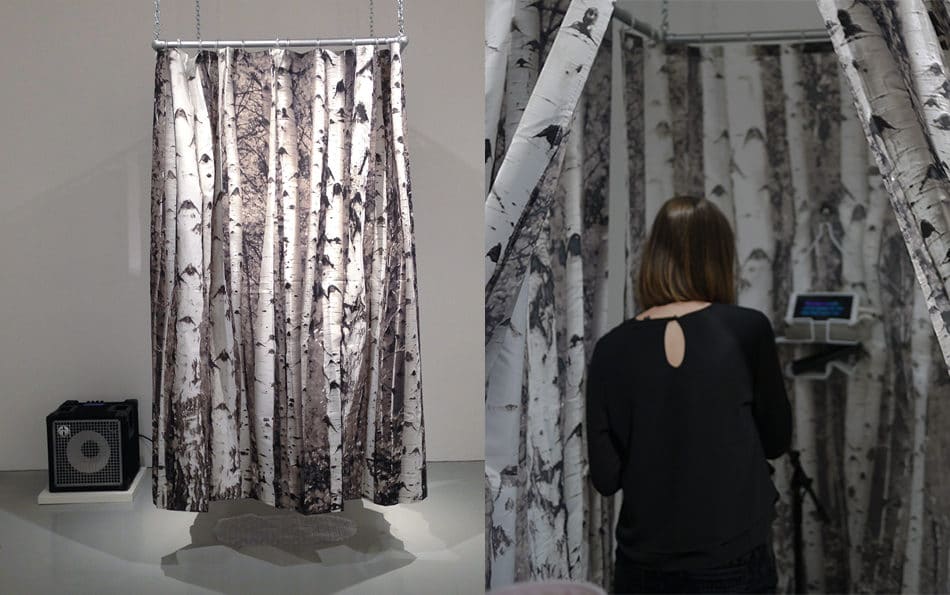
Wonderwall, 2014

Wonderwall (karaoke booth), 2014
Shower curtains, shower fixture and caddy, iPad, microphone, headphones, speaker

Wonderwall was a site-specific installation that consisted of a karaoke booth that mimicked a shower stall.  Individuals were instructed to sing along to the music they heard threw headphones as the lyrics appeared on a monitor in front of them. The a-cappella vocals were audible throughout the gallery space during the exhibition. Each performance was recorded and layered into a single track, creating the illusion of a choir.

Wonderwall, 2014 — artwork by artist Bradly Brown


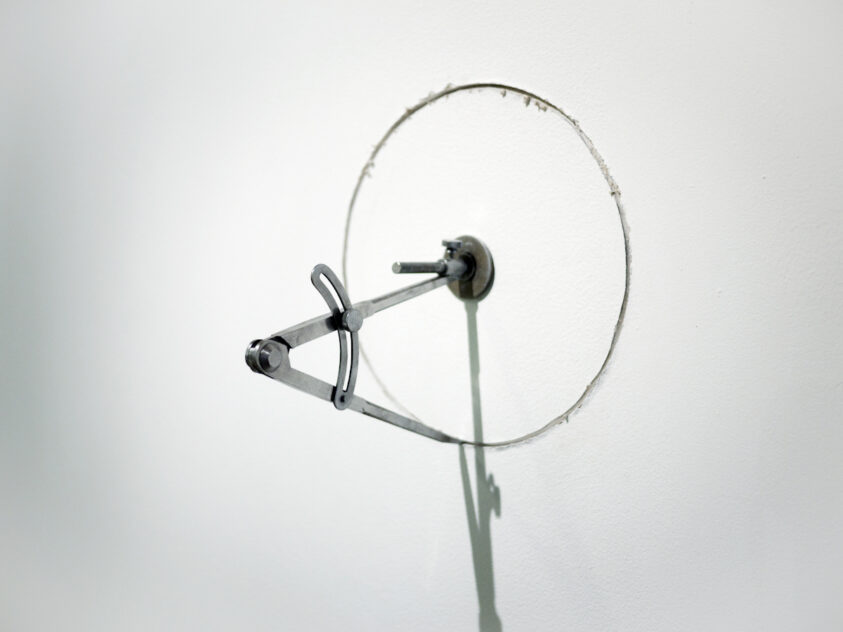
Escape Plan, 2012

Escape Plan, 2012
Drafting compass, drywall, motor, hardware

Exhibited in Acceleration, Dallas Contemporary, Dallas, TX, 2013

Press: “Acceleration at Dallas Contemporary’s Alive for 35 Spans Generations”, Betsy Lewis, Dallas Observer, November 11, 2013

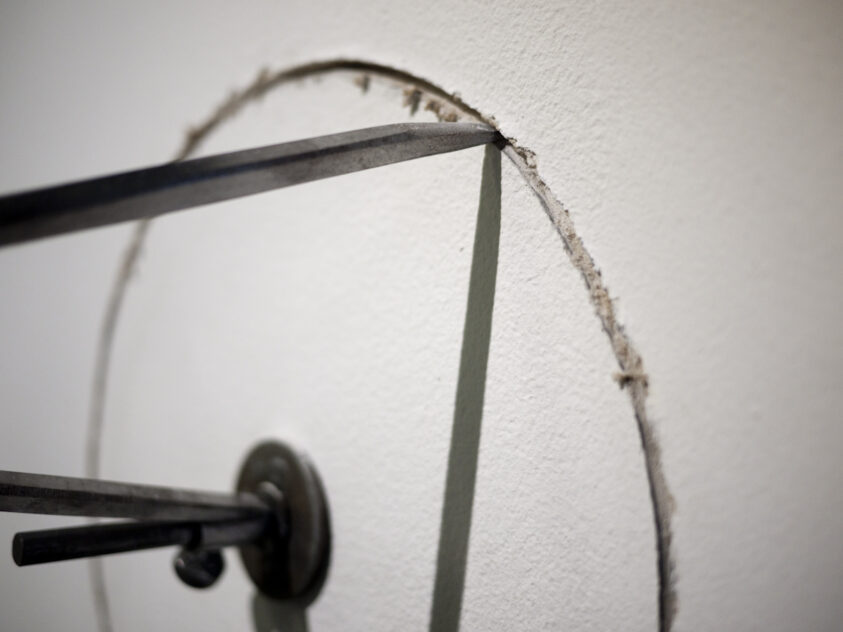
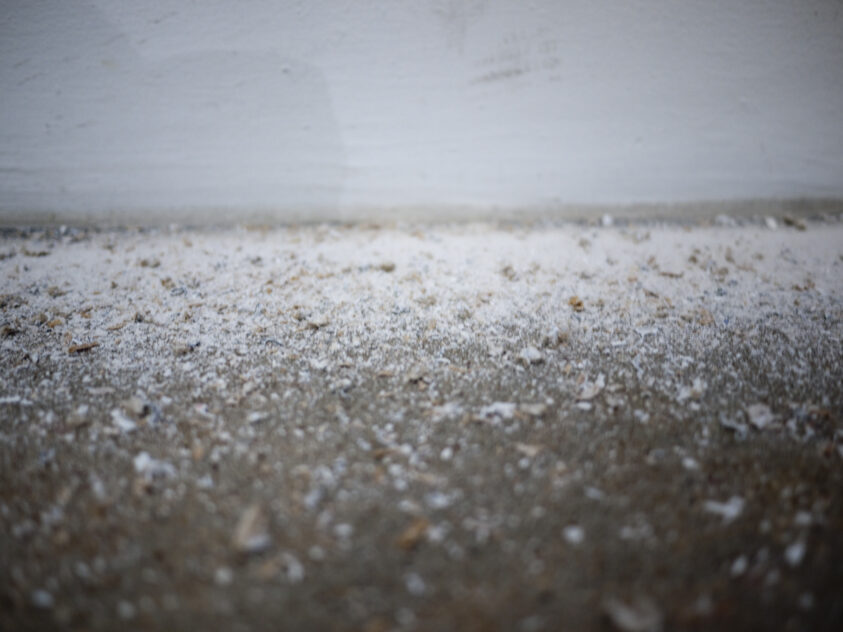
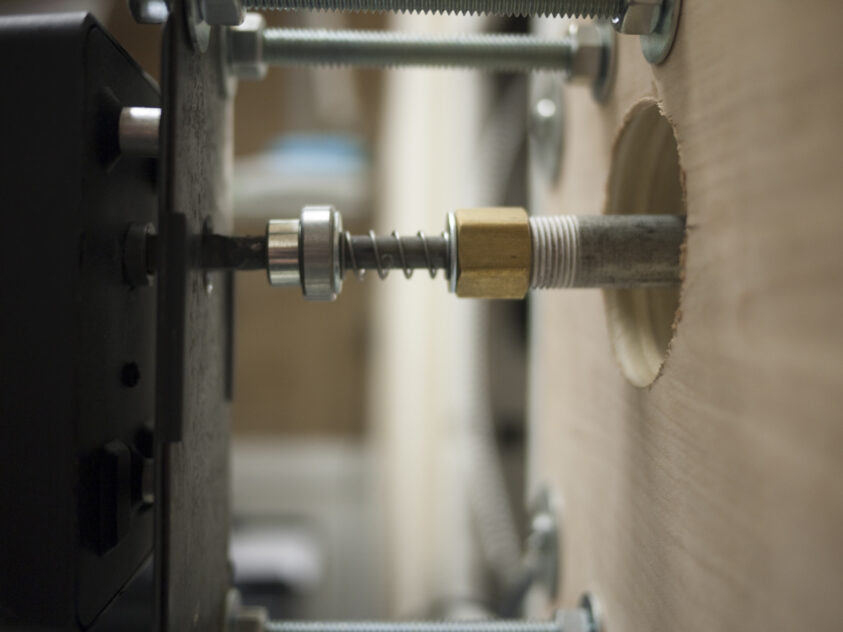
A drafting compass turns on a rod driven through the gallery wall, rotated once every thirty seconds by a rotisserie motor on the other side. A spring pulls the point into the drywall, so each pass cuts the circular groove a little deeper. Given enough time, the compass would cut all the way through the wall.

Escape Plan is about endurance and repetition: a small, pointless gesture repeated long enough leaves a real mark. Now and then the compass catches in its own groove and hesitates, and viewers find themselves rooting for it, a reminder of how quickly we empathize with something that struggles.

Waiting Room, 2016

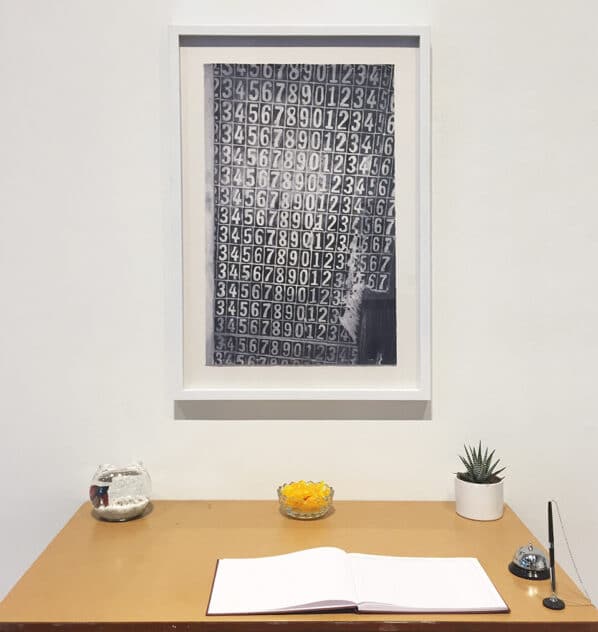
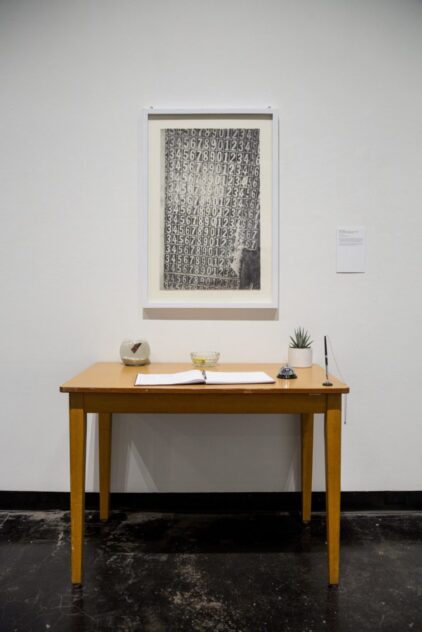
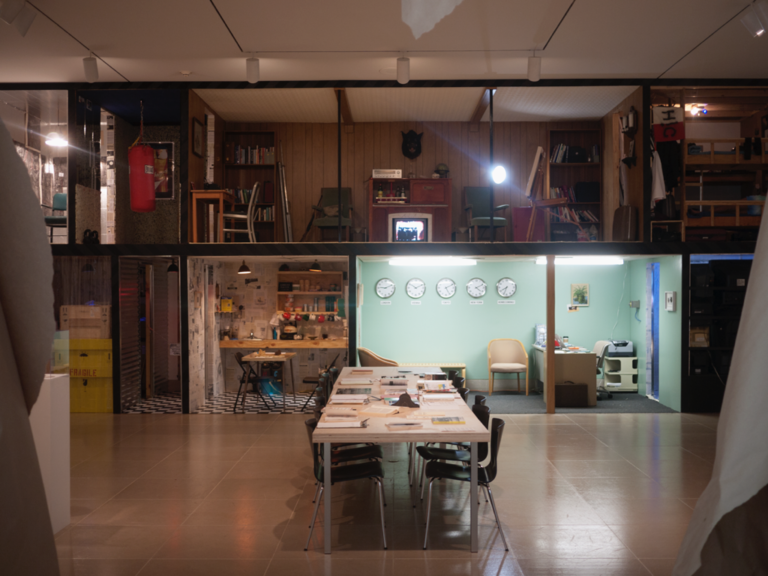
Waiting Room was made as the set for Act I of a three-act play that was never finished. It was shown in 2016 at Lawndale Art Center in Houston in Double Digits: Lawndale’s Artist Studio Program, 10 Years and Counting, a group exhibition celebrating the thirty artists who took part in Lawndale’s Artist Studio Program in its first ten years.

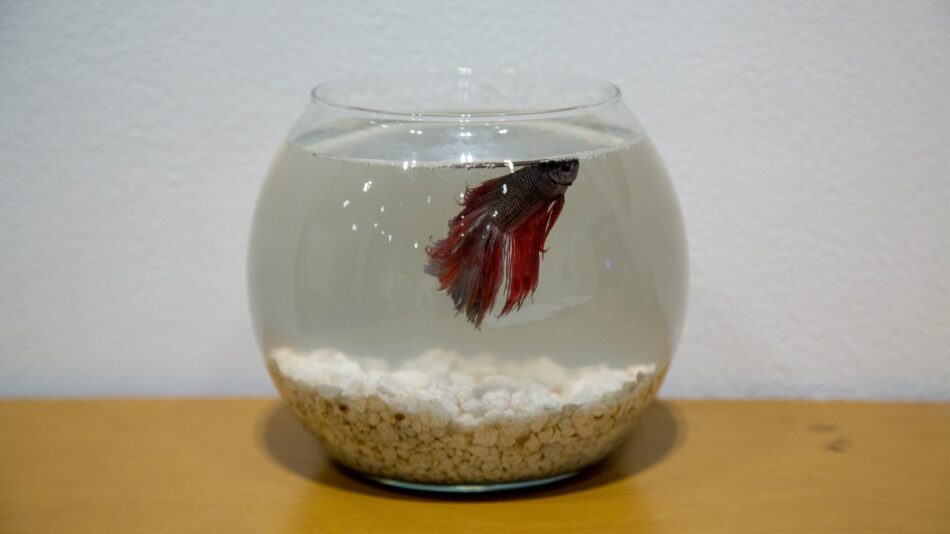
The installation is a reception desk with no receptionist. It has a sign-in book and pen, a bowl of candy, a small succulent, a service bell, and a fishbowl holding a live betta fish named Ennui. Visitors were welcome to sign in, but nobody told them what they were signing in for, and no name was ever called. A charcoal and graphite drawing of numbers hangs above the desk where a clock would be. Every number shows at once, so time looks stopped, or broken, or no longer counting toward anything. (Ennui was not harmed in the making of this work, and lived another five years after the exhibition.)

The work is limbo. Limbo is a waiting room for eternity, where you’re processed but never seen. The installation brings that state down to the scale of an ordinary lobby, the kind of place where everyone has waited without knowing how long it would take or whether anyone was coming.

Act I: Waiting Room (detail), 2016
Charcoal and graphite drawing, betta fish, candy bowl, succulent, sign-in book, bell and pen.
Dimensions variable

Waiting Room detail: framed charcoal and graphite drawing of numbers above a desk with a fishbowl holding a betta fish, candy dish, sign-in book, service bell, succulent, and pen, 2016 by Bradly Brown
Waiting Room installation view: framed charcoal and graphite drawing of numbers above a wooden desk with a fishbowl holding a betta fish, candy dish, sign-in book, service bell, succulent, and pen, 2016 by Bradly Brown
Ennui, a red betta fish, swimming in a round glass fishbowl with white gravel on a wooden desk, part of Waiting Room, 2016 by Bradly Brown
Ennui, the live betta fish in Waiting Room, 2016.

Columns, 2015–2016

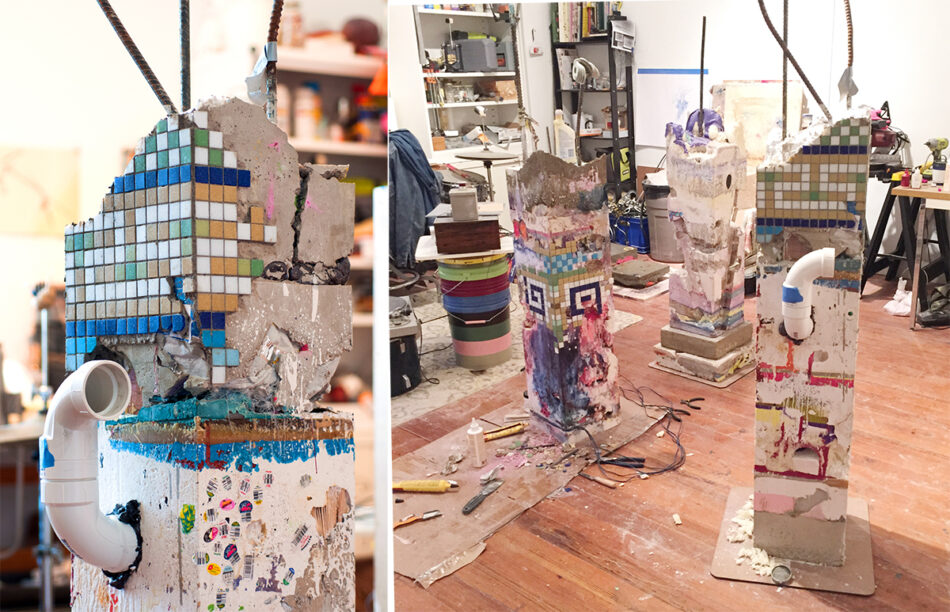
Act III: Columns (1-3), 2015-2016
Artificial turf, black beauty abrasive, plaster, cement, wax, chocolate, bacon fat, Vaseline, clay, resin, foam, glass, ink, debris, found objects, speakers, and record player
Dimensions variable

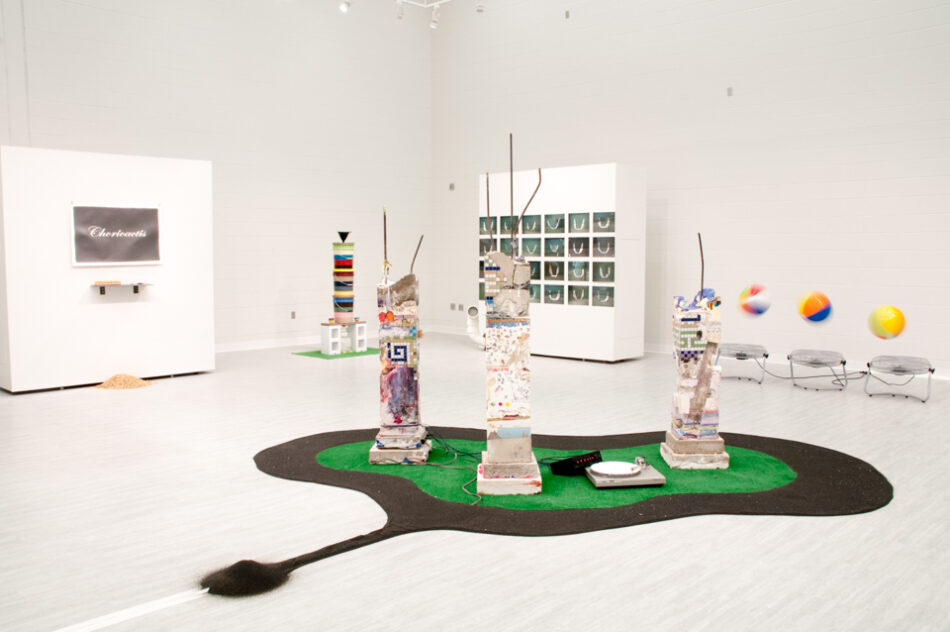
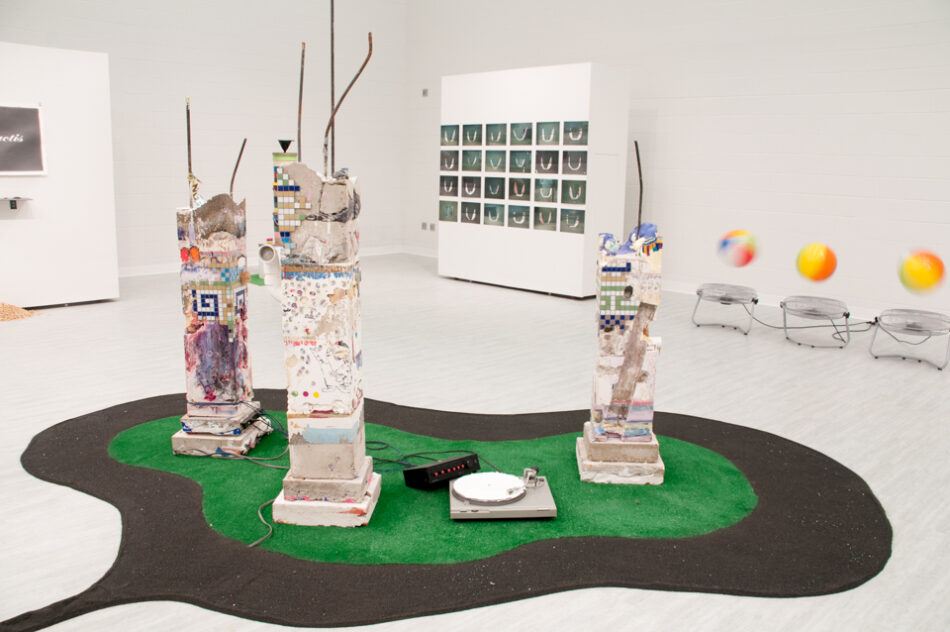
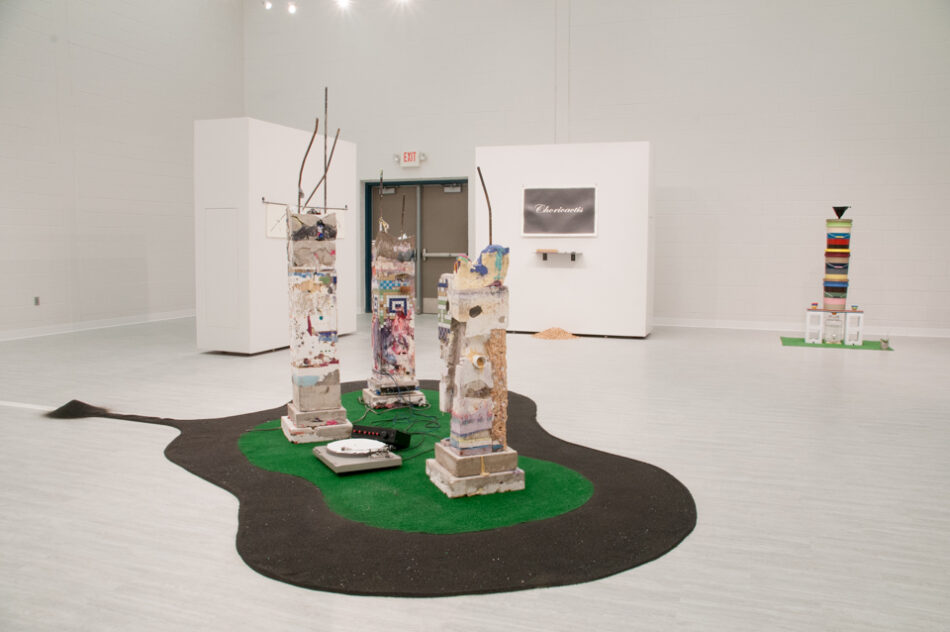
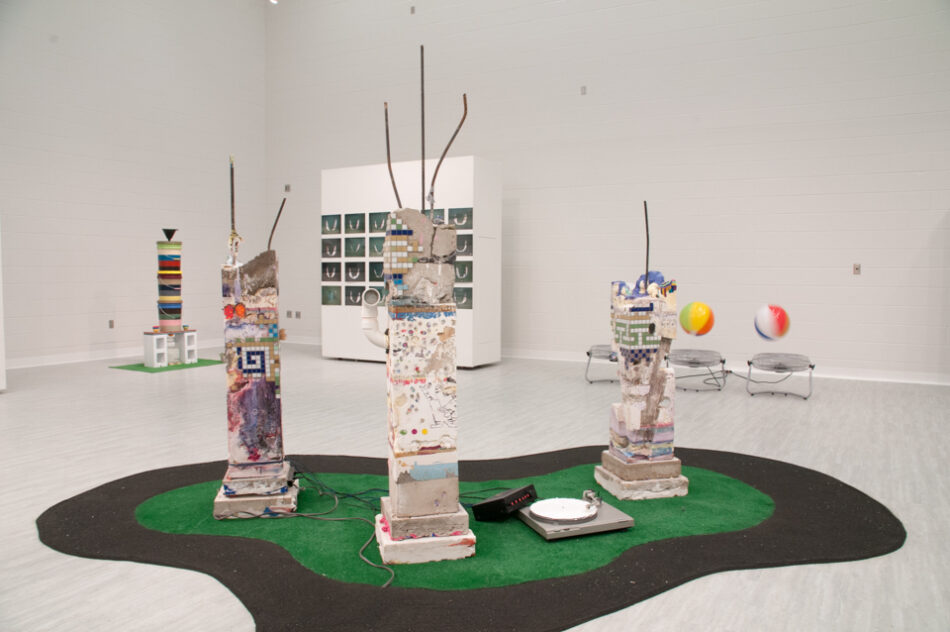
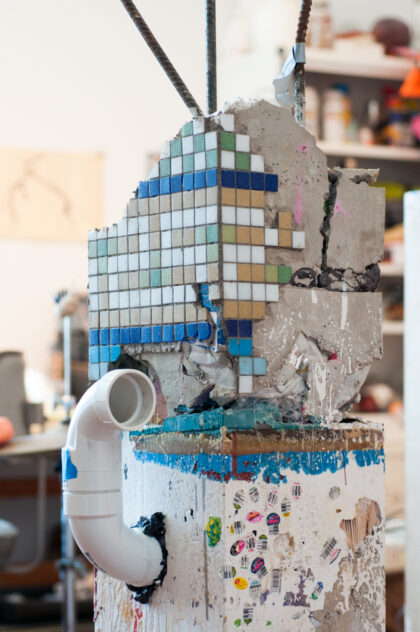
Act III: Columns (1–3) was made during Brown’s time in the Lawndale Artist Studio Program. It is the final act of a larger narrative that also includes Act I: Waiting Room and the records of Side A. Together, the works form the set for an unfinished three-part play that is still missing its second act.

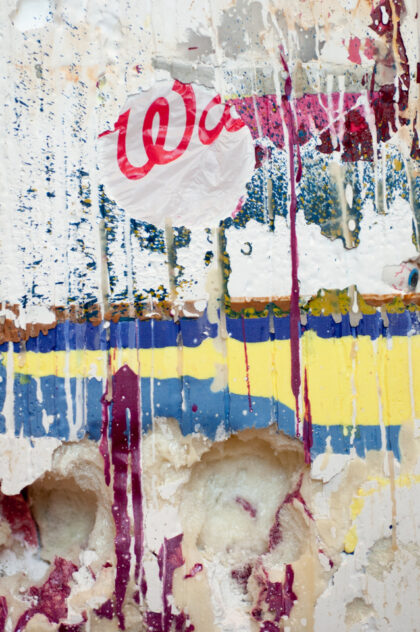
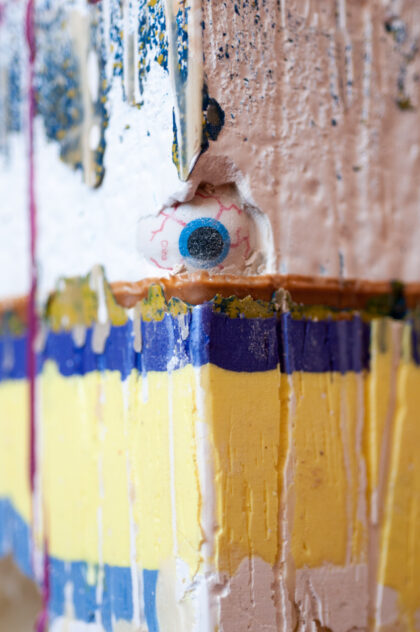
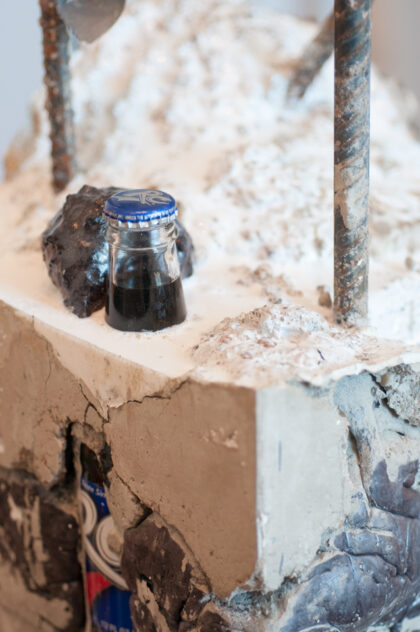
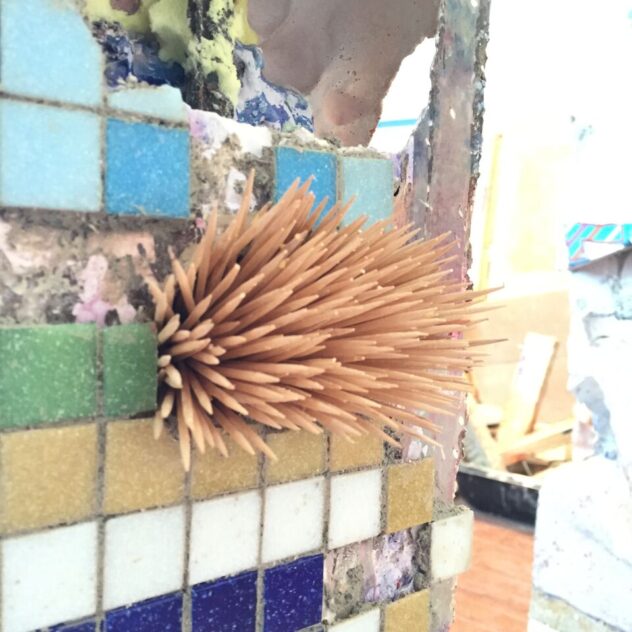
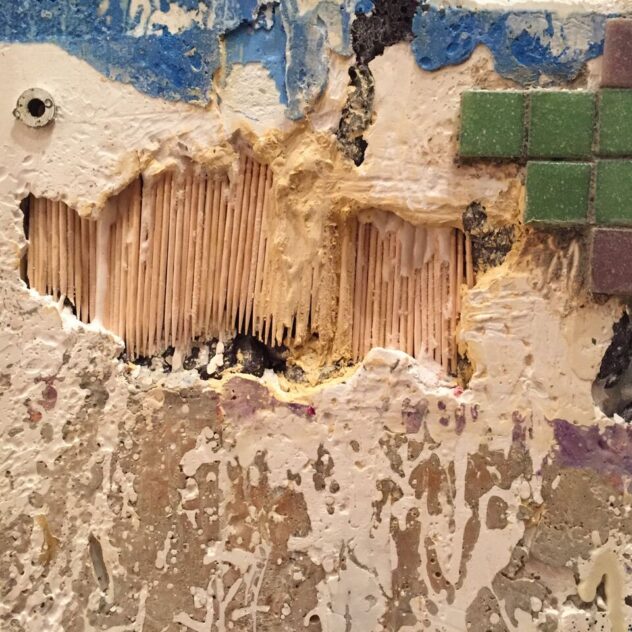
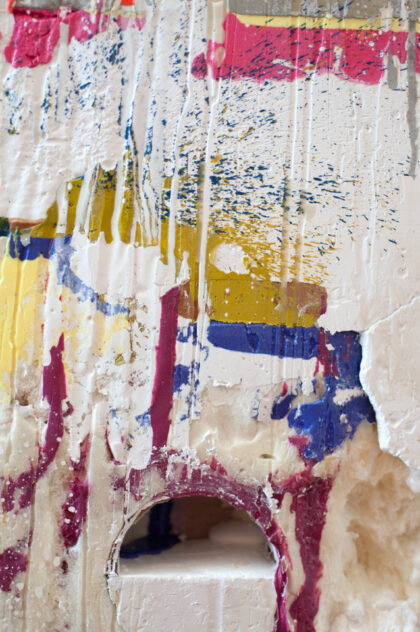
The work consists of three broken columns, the ruins of a structure that once stood. To make them, Brown built three adjustable housings and, over the course of the residency, filled them with studio waste, found objects, ephemera, trash, and other things he had collected. Between layers of objects he poured phase-changing materials, substances that turn from liquid to solid: two-part plastics, silicone rubber, resin, wax, concrete, plaster, and even chocolate and bacon fat. Rebar ran through each mold, both for reinforcement and to exaggerate the broken condition of the finished pieces. Each column became a kind of time capsule.

When the walls of the molds came off, many of the hidden objects revealed themselves through cracks and broken sections, and Brown excavated parts of the columns to expose even more. He then applied a patchwork of tiles over sections of each column, suggesting how they looked originally, before they began to decay and fall apart.

Conceptually, the work is about the giant structures we trust every day without question: physical ones like buildings and bridges, but also institutions like banks, governments, and commercial giants. We only ever see them from the outside, and what lies beneath that thin shell may be very different. The piece was inspired by a 2016 news story from Taiwan, where an earthquake brought down an apartment building and revealed tin cans packed inside its pillars.

The three columns sit on an island of artificial turf surrounded by black sand. Their soundtrack comes from the records of Side A, another picture of a fragmented culture: bits and pieces joined together in an attempt to make the semblance of a whole. The result scratches, skips, and gets stuck repeating its blemishes until someone moves the needle.

Side A, 2016

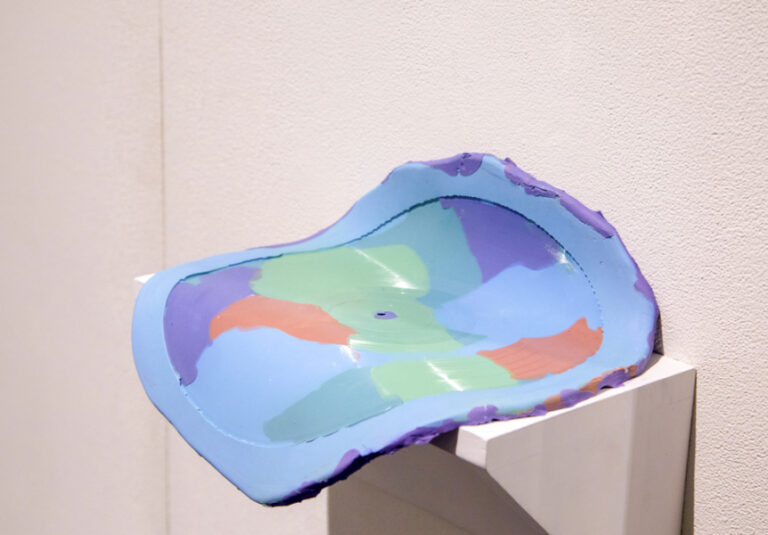
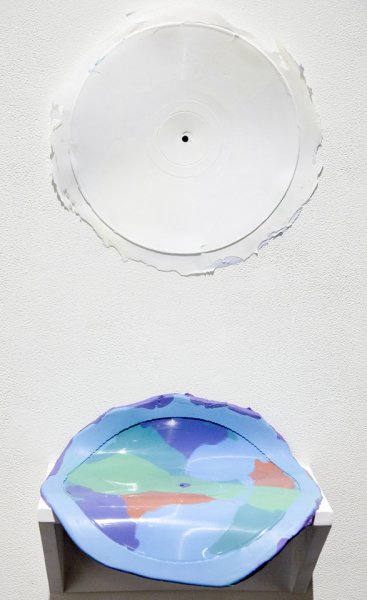
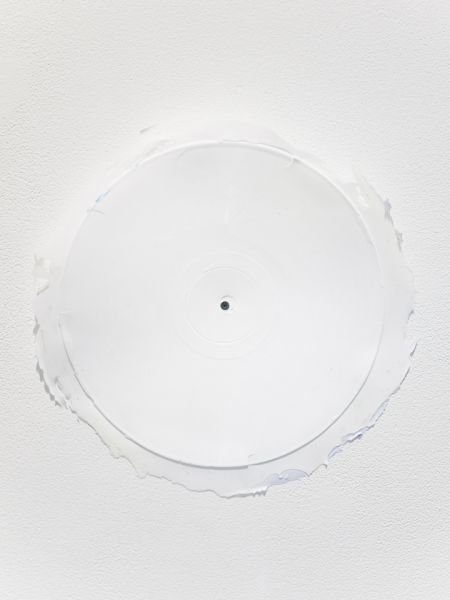
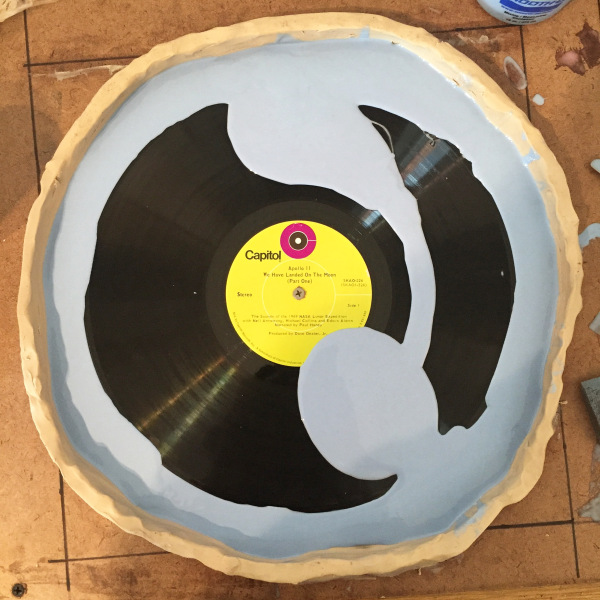
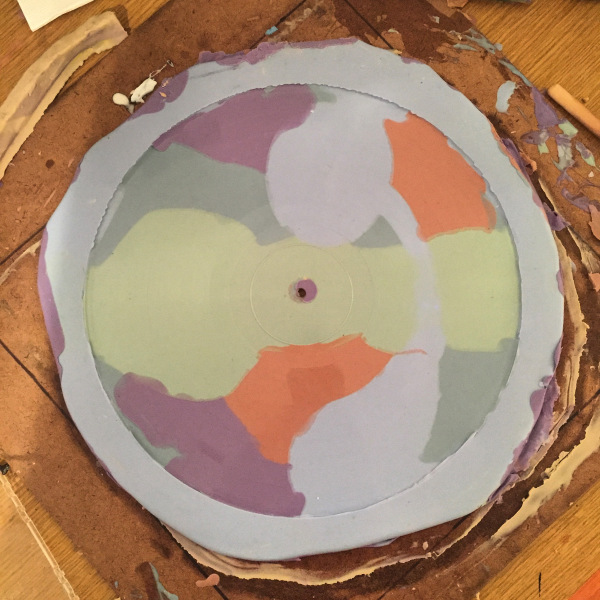
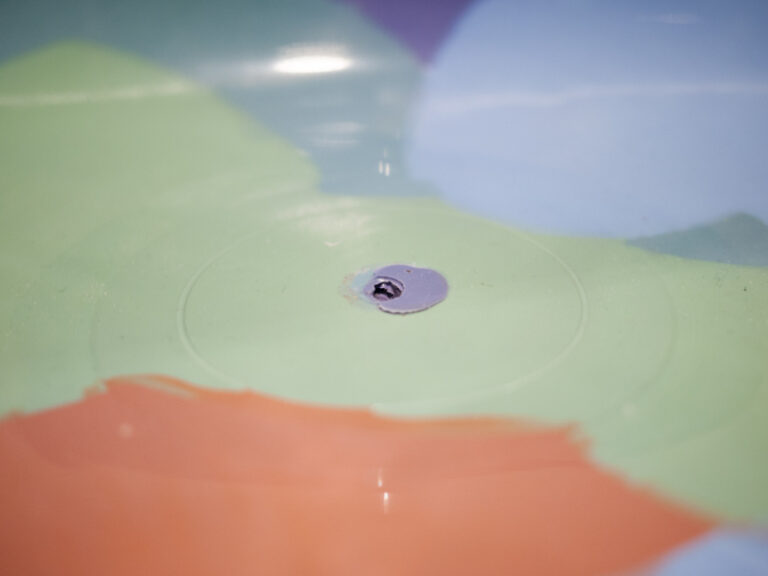
Side A, 2016
Silicone mold, and unique resin cast LP. Each color of silicone signifies a different vinyl record used to create the mold. 
14” x 14” each

Side A is a single silicone mold cast from five different vinyl LPs. Silicone was poured over one record, peeled away, and laid onto the next, building up layer by layer, with each color of silicone marking a different record.

Resin records cast from the mold carry that layered information and can be played. The five LPs melt into one another, an abstraction of both image and sound, so the record sounds different depending on where the needle drops.

The Side A records also became the soundtrack for Act III: Columns (1–3), part of a larger narrative with Act I: Waiting Room. There, the records stand for a fragmented culture: bits and pieces joined together in an attempt to make the semblance of a whole. The result scratches, skips, and gets stuck repeating its blemishes until someone moves the needle.

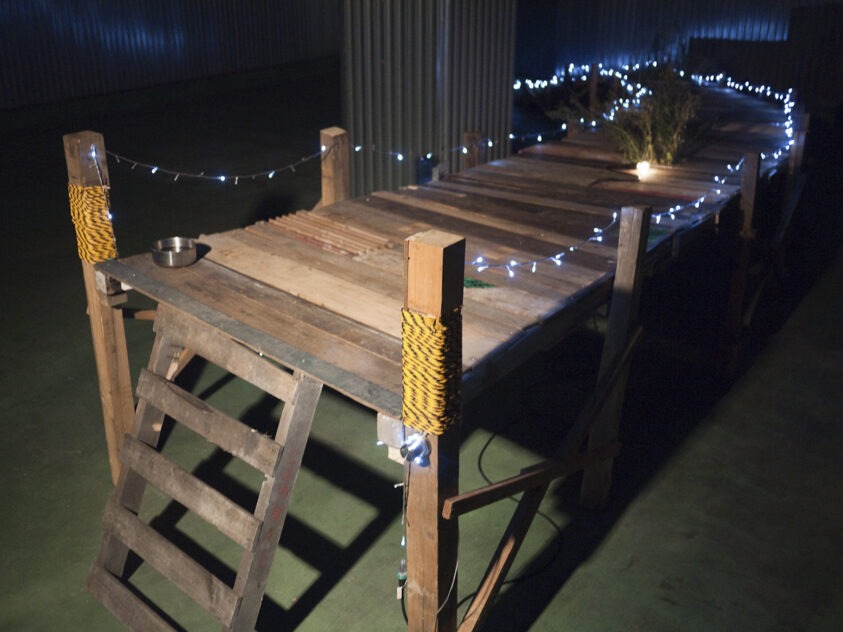
Damemoto (Nothing to Lose), 2012

Damemoto (Nothing to Lose), 2012
Reclaimed wood, weeds, lights, water bowl, hardware

Exhibited in Sons and Daughters of the Sun and Star II, Hiroshima City University, Hiroshima, Japan, 2012

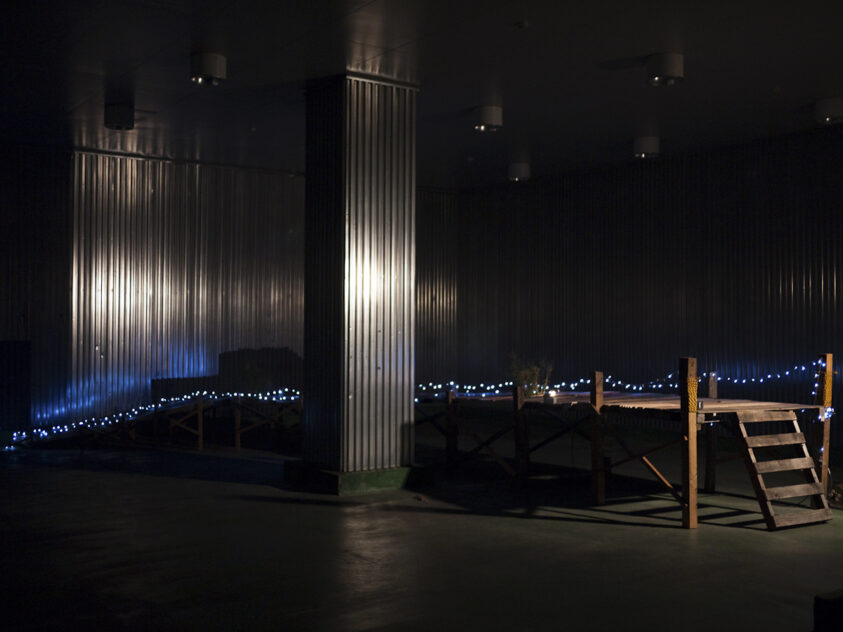
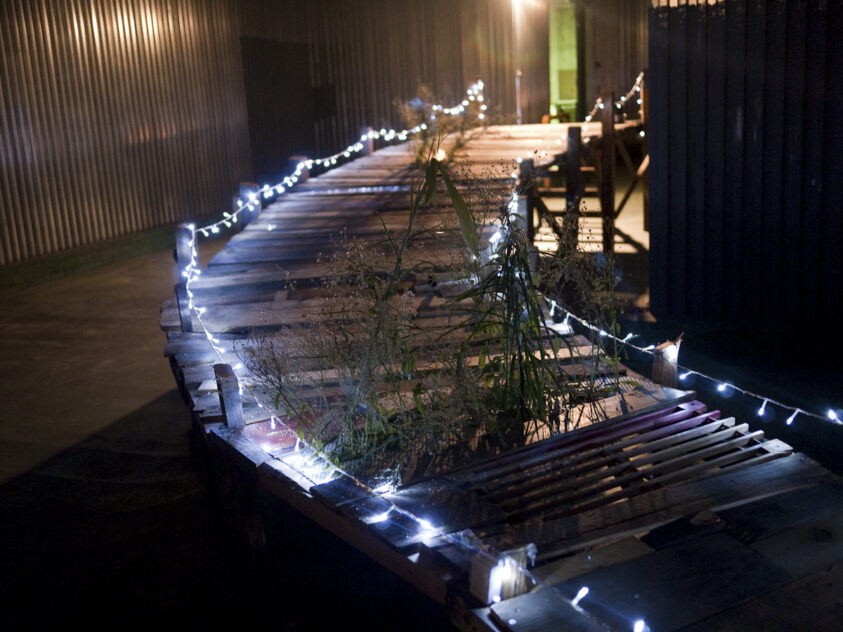
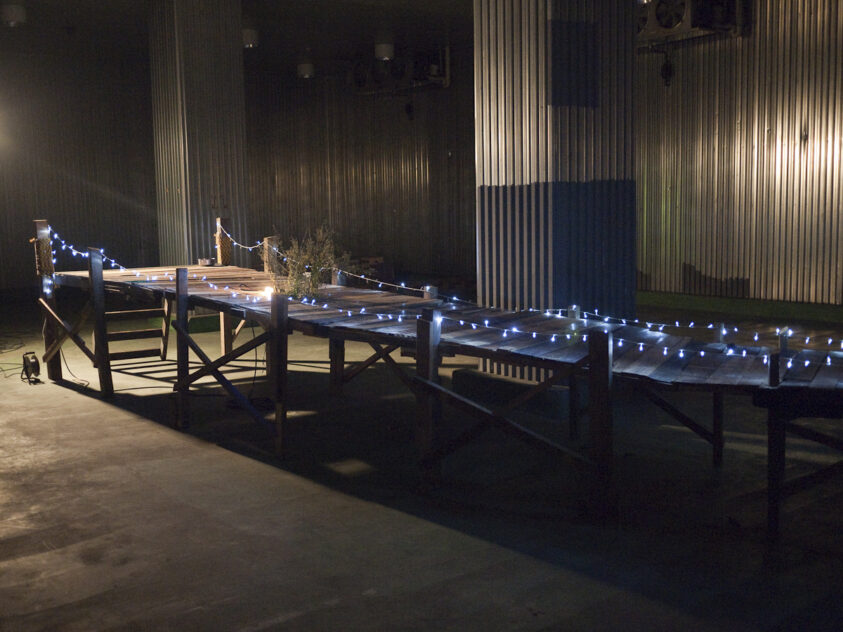
The March 11, 2011, Great East Japan earthquake and tsunami sent millions of tons of debris drifting across the Pacific Ocean, and much of it washed up on the West Coast of the United States and Canada. In June 2012, a 66-foot concrete and metal dock from Misawa, Japan, came ashore at Agate Beach, Oregon.

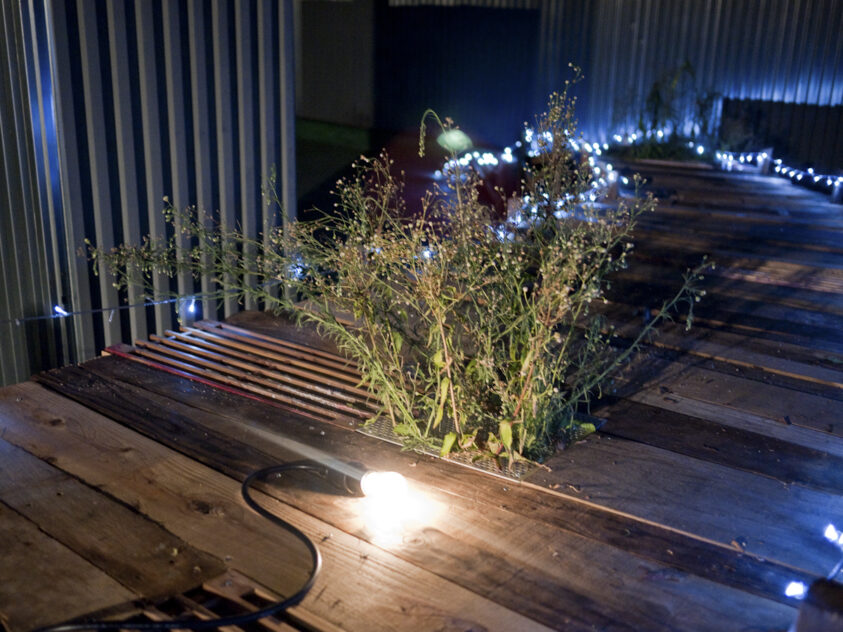
Brown made Damemoto in Hiroshima that year, as part of Sons and Daughters of the Sun and Star, an exchange program between Texas Christian University and Hiroshima City University. The long, low pier was assembled from debris from the 2011 earthquake, with clumps of weeds growing up through its planks and strands of blinking string lights running its length. It was meant as a literal bridge and dock between the two countries, a path for help to travel during a huge tragedy. Writing in the exhibition catalog, Kenji Kajiya described the lights as honoring the dock’s “mighty voyage across the sea.”

The bilingual exhibition catalog, with essays by Lucia Simek and Kenji Kajiya, is available as a PDF: Sons and Daughters of the Sun and Star catalog (PDF, 3.4 MB). See also Transpacific, made for the Fort Worth half of the exchange.

Transpacific, 2012

Transpacific (a line drawn from Texas to Japan), 2012
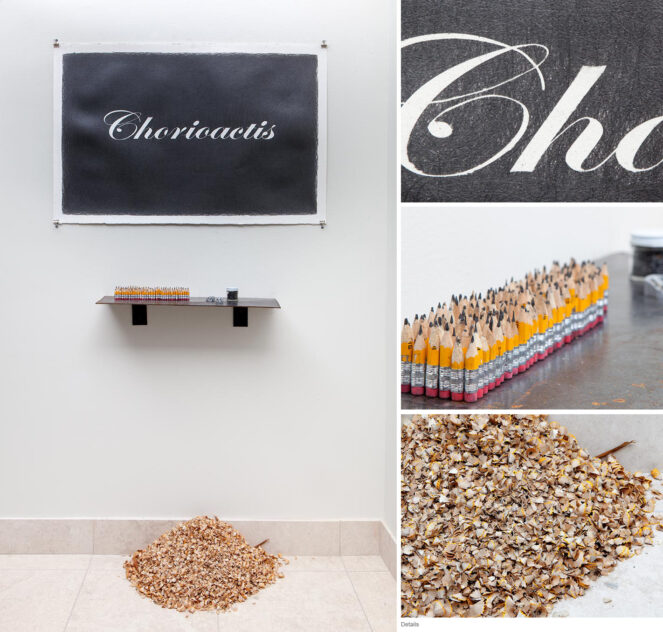
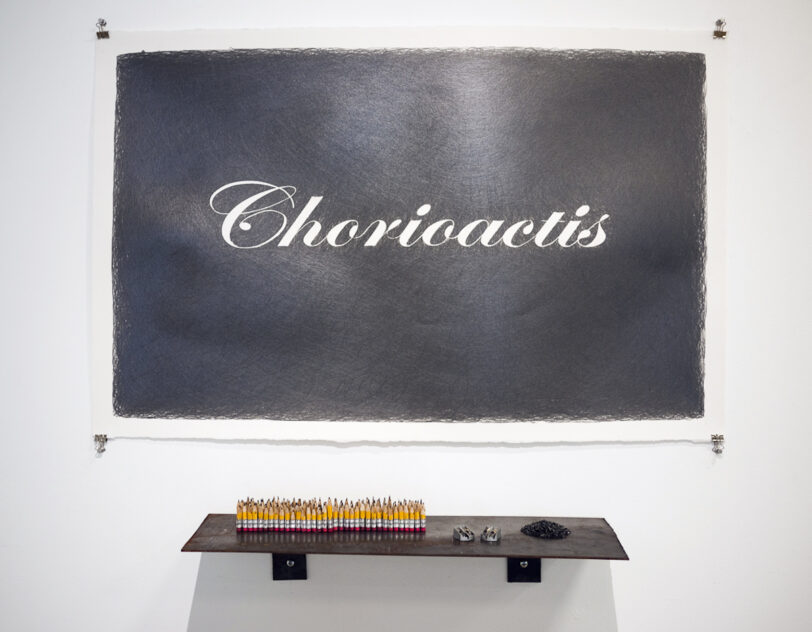
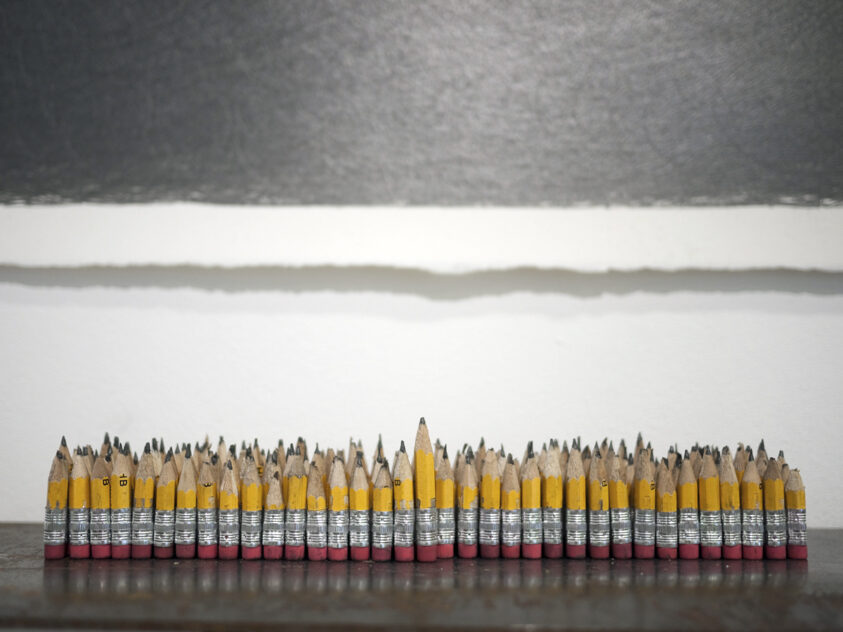
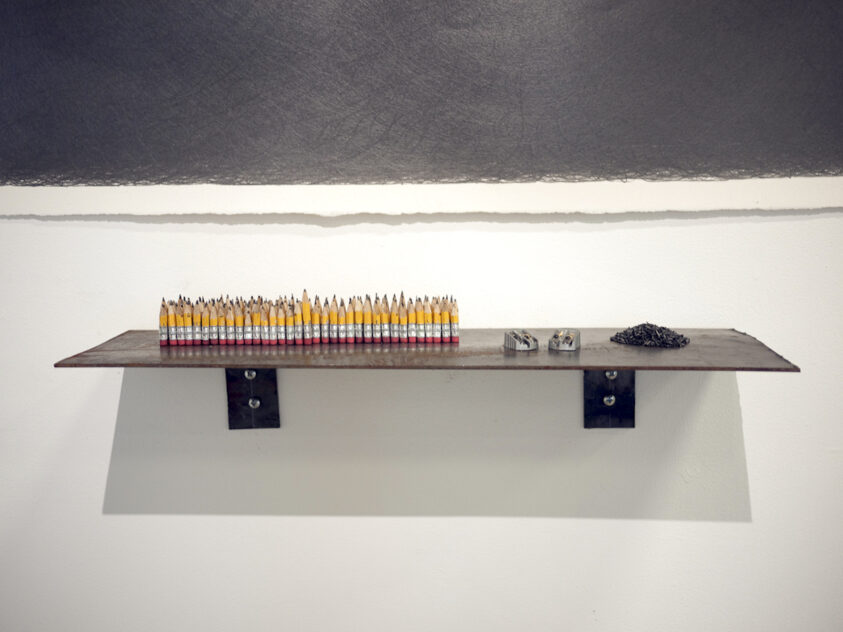
194 #2 pencils, paper, steel, pencil sharpeners
40″w x 72″h

Exhibited in Sons and Daughters of the Sun and Star I, Fort Worth Contemporary Arts, Fort Worth, TX, 2012
Catalog: Sons and Daughters of the Sun and Star (PDF). See also Damemoto, made for the Hiroshima half of the exchange.

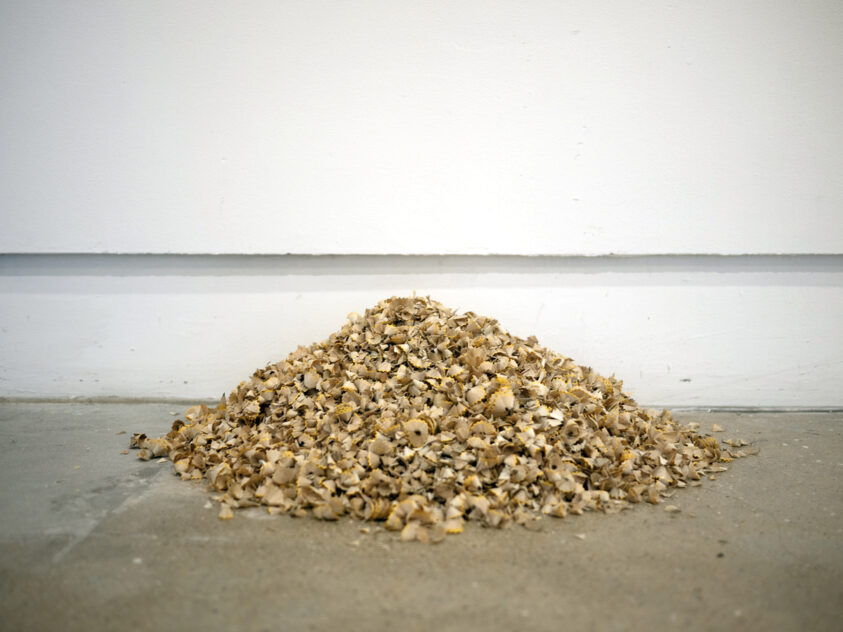
Made for an exchange between Texas Christian University and Hiroshima City University, Transpacific is one continuous line drawn with 194 pencils on a single sheet of paper. By the old claim that a pencil can draw a line 35 miles long, together they hold about 6,790 miles of graphite, the distance from Fort Worth to Hiroshima.

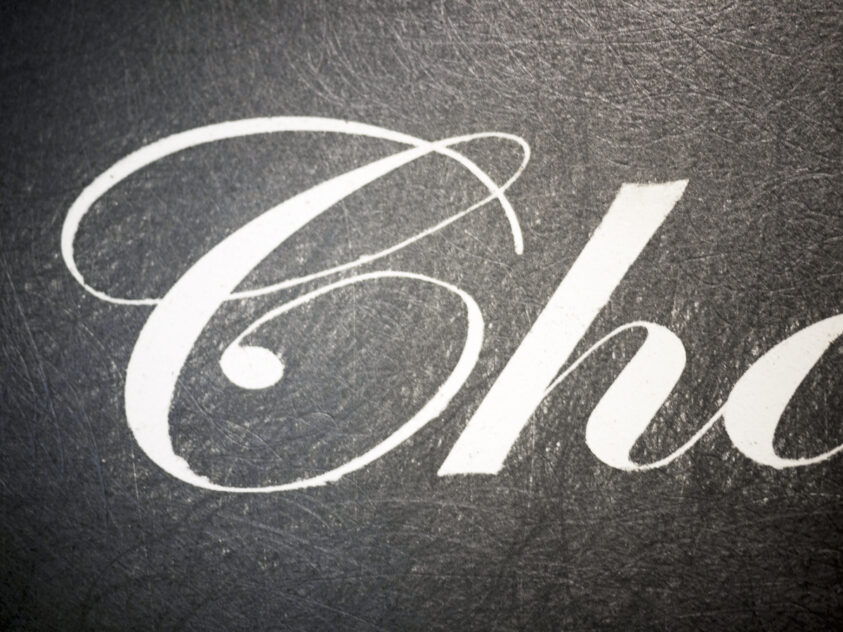
The word Chorioactis is masked out and left blank. It is the Latin name of a rare mushroom, the Devil’s Cigar or Texas Star in the United States and kirinomitake in Japan, that grows only in a few isolated places in Texas and Japan. The drawing’s repeated marks echo its spores drifting between the two, carried by wind and chance. The piece is shown with everything left from the 194 pencils: broken tips, shavings, and stubs sharpened down as far as they would go. In her essay for the exhibition catalog, critic Lucia Simek pointed to Transpacific as a record of the exchange itself, the artists’ actual journey between the two cities rendered in graphite.

Attention Retention, 2012

Attention Retention, 2012
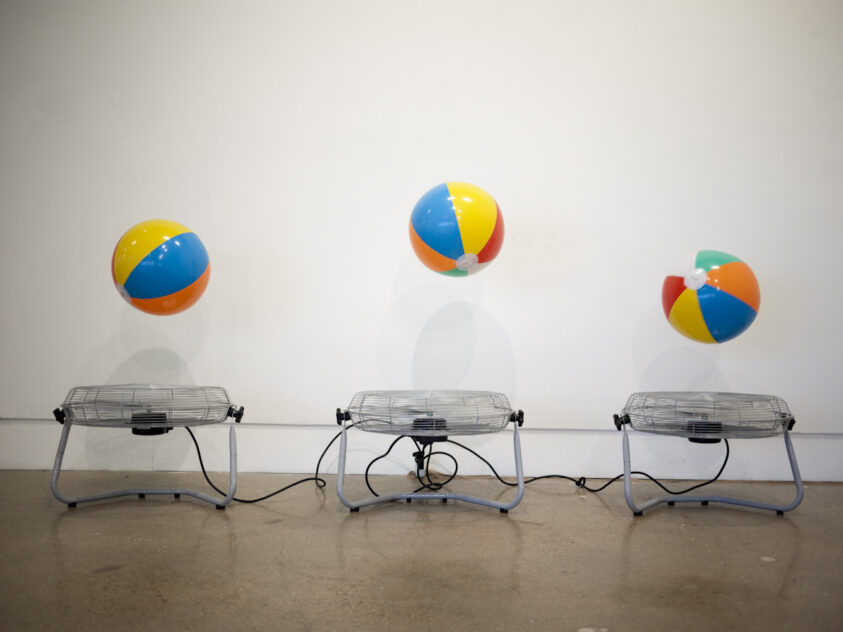
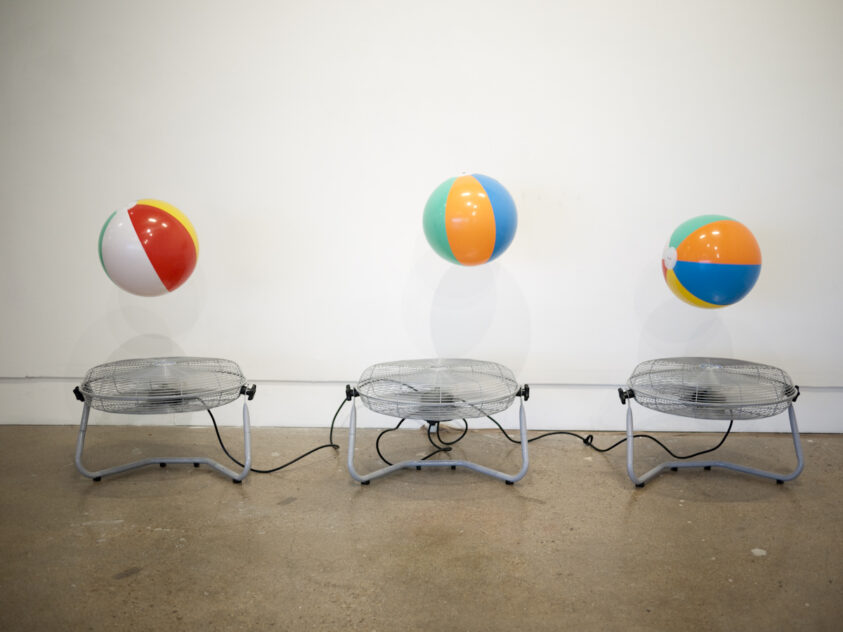
Three floor fans and three 16″ beach balls

Exhibited in For a Limited Time Only, Brown’s TCU MFA thesis exhibition, Fort Worth Contemporary Arts, Fort Worth, TX, 2013. Named one of the Top Five Artworks in Fort Worth Weekly’s Best of Culture 2013.

Walking through Walmart one day, Brown saw about six people gathered around a product display. Under a sign reading “Clearance—High Velocity Floor Fans—$34,” a chrome fan pointed straight up on full blast, with a multicolored beach ball hovering in the air above it. Bernoulli’s principle keeps the ball in place: fast-moving air has lower pressure than still air, so the stream wraps around the ball, pushes it back to center whenever it drifts, and holds it aloft. It’s a trick many people remember from junior high physics or a children’s science museum.

What caught Brown’s attention wasn’t the trick but the shoppers, who stood transfixed. The display held people longer than most viewers spend with an artwork in a museum or gallery. Would the same device hold an audience the same way if it were presented as an art object? Could it work as a Duchampian readymade once it was moved into a gallery?

Attention Retention takes that question into the gallery as a kind of social experiment. Three floor fans sit in a row, each levitating a 16″ beach ball. The balls bob in a constant rhythm, filling the room with color and repetitive motion that is hypnotic, holding the viewer’s gaze while demanding attention.

In a world of media saturation and nonstop information, attention has become a sought-after commodity. One 2008 study found that the average attention span had dropped to five minutes, down from twelve a decade earlier. Placed in a gallery, the piece becomes a constant distraction that changes how the whole space is experienced. A moving object in a still room is a kind of seduction: even viewers who aren’t looking at it keep it in their peripheral vision or steal quick glances. That pull is a survival instinct. The brain reads movement in a quiet space as one of three things: a predator, a source of food, or a potential mate.

The repetitive bobbing also gives the beach balls a kind of personality, and viewers begin to relate to them as if they were alive. Attention Retention was part of For a Limited Time Only, Brown’s 2013 MFA thesis exhibition at TCU, which looked at how attention, behavior modification and the drive to survive shape everyday decisions. See also Escape Plan and Purification Station, which were shown in the same exhibition.

Purification Station, 2013

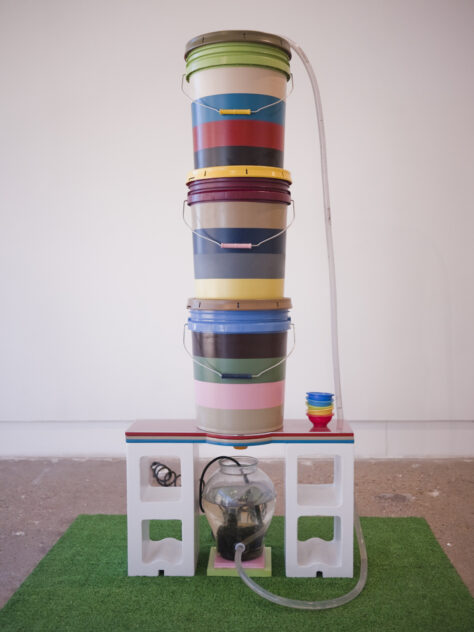
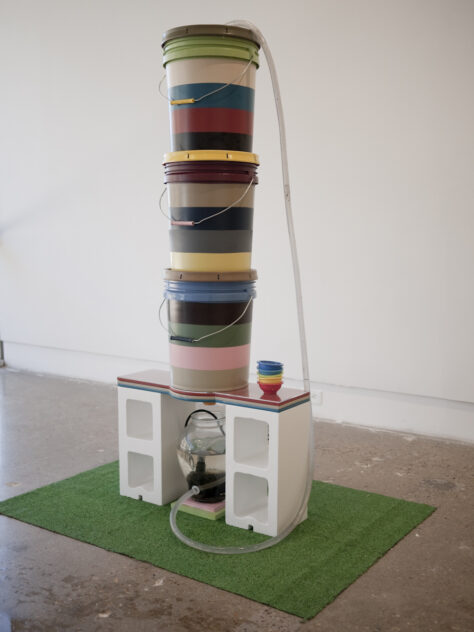
Purification Station, 2013
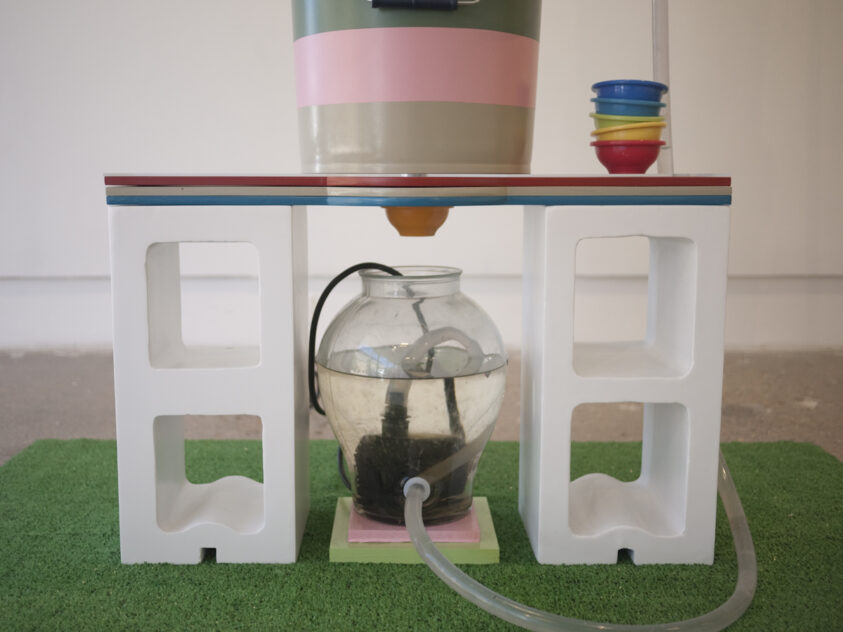
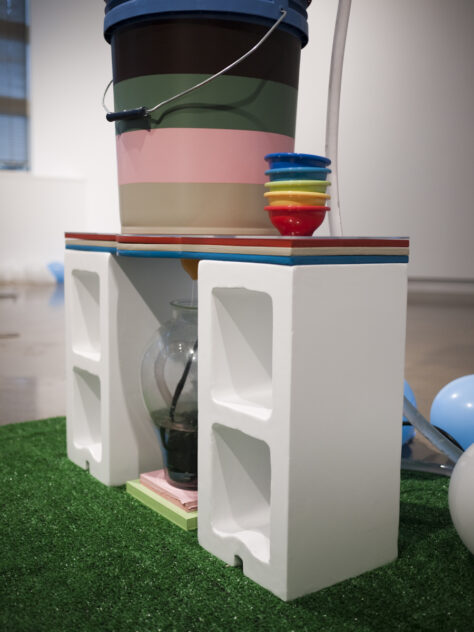
Plastic, Trinity River water, pecan & rose artesian charcoal, white marble chips, beach sand from Exotic Locations™, pump, and glass beverage dispenser
50″w x 61″h x 35″d

Exhibited in Experiencing Perspectives, Mercedes-Benz Financial Services, Fort Worth, TX, 2013
Exhibited in For a Limited Time Only, Brown’s TCU MFA thesis exhibition, Fort Worth Contemporary Arts, Fort Worth, TX, 2013

An emergency water filter is meant to be scraped together from whatever is at hand: buckets, cinder blocks, sand, gravel, and charcoal. Purification Station rebuilds that system with a glossy pop finish, so it looks like something you could pick up at Target, and runs Trinity River water through pecan and rose charcoal, marble chips, and beach sand from Exotic Locations™.

Survivalism has become a lifestyle and a product category, fed by reality TV and recurring end-of-the-world headlines. The piece looks at how styling shapes what we believe an object can do, and how quickly survival tools turn into decoration. Like Several Ways to Start a Fire, it is an art object as long as the art market holds and a working tool if it doesn’t.

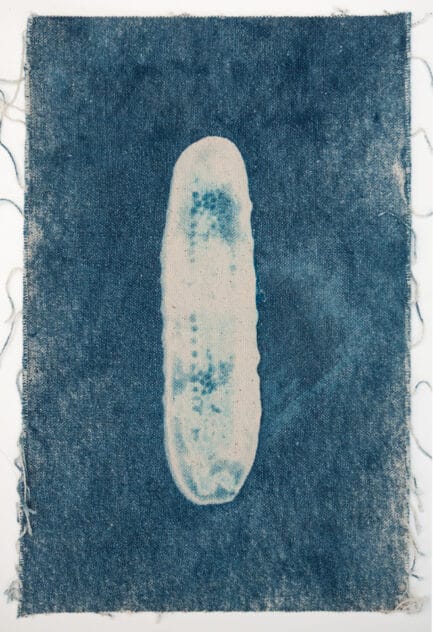
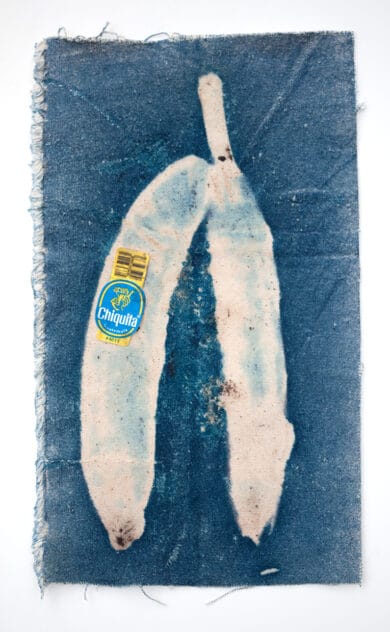
Low Hanging Fruit, 2018

Low Hanging Fruit, 2018
Cyanotype on canvas with product labels
variable sizes

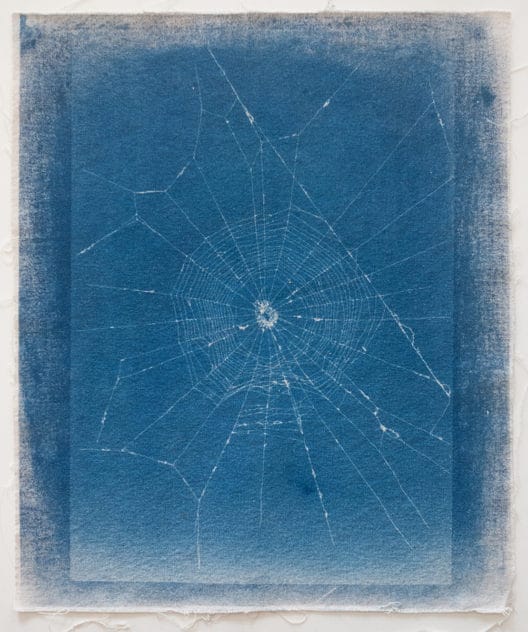
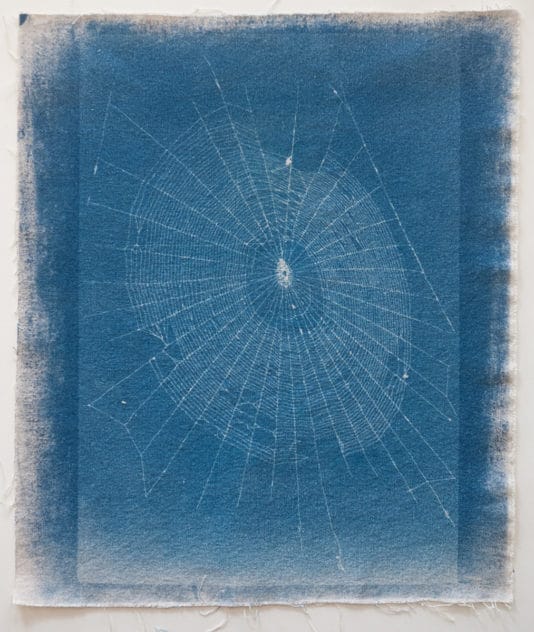
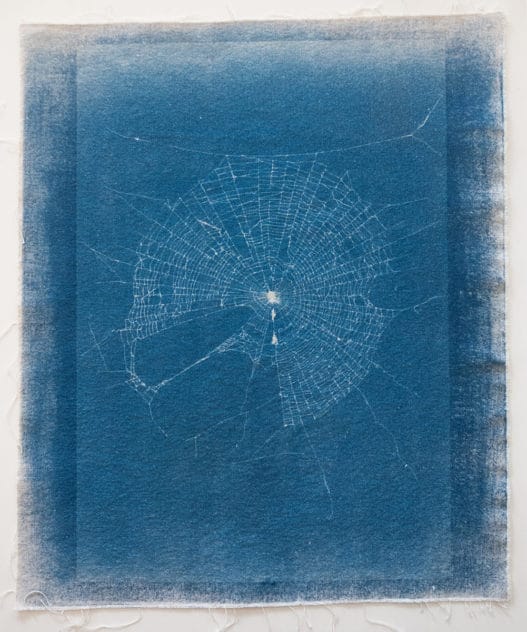
Spider Webs, 2017

Spider Webs, 2017
Cyanotype on canvas
16.5″w x 20”h

Exhibited in Image for Concept: Indirect Representation in Photography, Southeast Museum of Photography, Daytona State College, Daytona Beach, FL, 2019, and The Hand Art Center, Stetson University, DeLand, FL, 2020

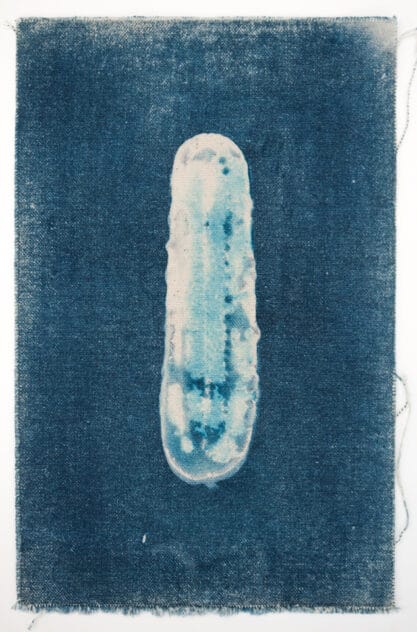
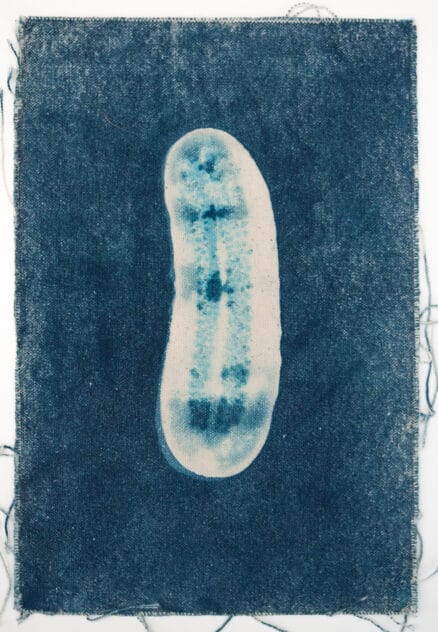
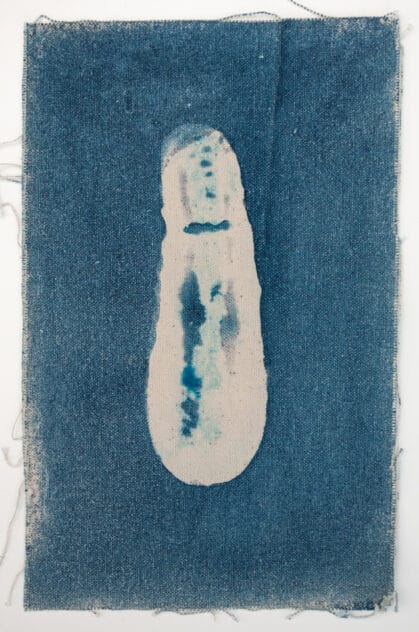
In Spider Webs, the computer monitor becomes a camera lucida. Working from photographs, Brown redraws each web by hand on screen, recognizing every thread while staying true to the original image.

The digital drawings are then printed as cyanotypes on canvas. The frayed edges of the canvas make each piece unique, yet the image itself is infinitely reproducible. Like the cliché verre, the 19th-century process of printing hand-drawn glass plates on photographic paper, the work asks how an art object is valued: what is a physical object worth compared to the digital information that defines it?

Spider Webs was made in 2017 during the North Set Residency in Houston, organized by Bea Ying Projects in a vacant commercial building that had once been a title loan office. In that setting the webs took on another meaning: they reference how title loan and other short-term lending companies can trap people in cycles of debt that are hard to escape, all in the pursuit of paradise, or the American Dream. The series was made alongside Title Loan, a group of cyanotypes on canvas from the same residency.

The series grows out of Brown’s larger interest in the blurring line between our physical and digital surroundings. Across installation, sculpture, photography and video, his work looks at how technology shapes our decisions, both enhancing and disrupting our sense of independence, and invites viewers to weigh its potential against its pitfalls and its effect on cultural and individual identity.

The web returns as a subject in UUUUUU (2023), a spiderweb hand-formed from copper wire stripped from internet cable.

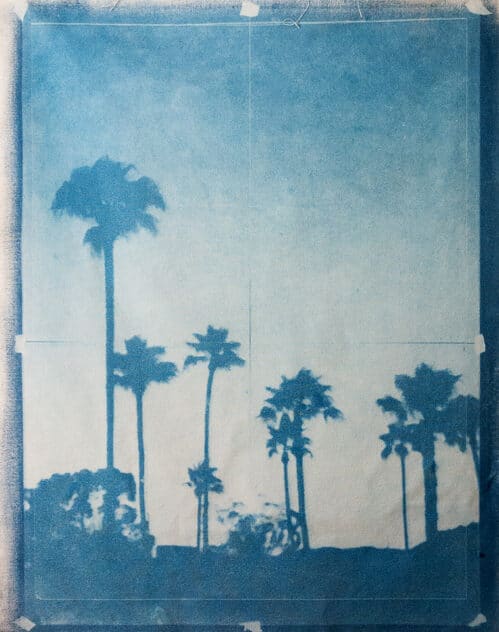
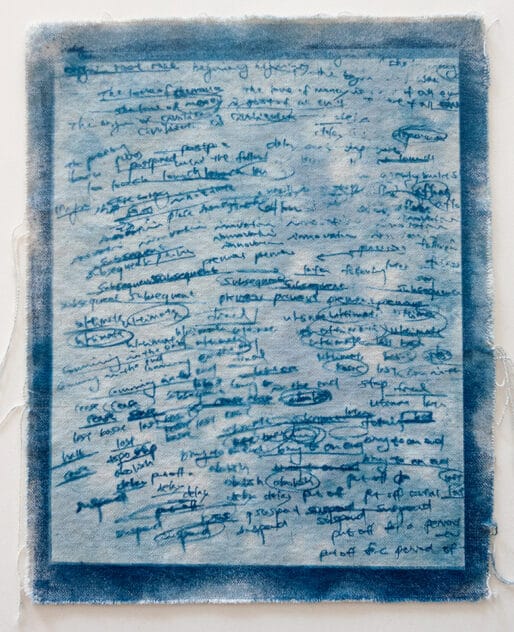
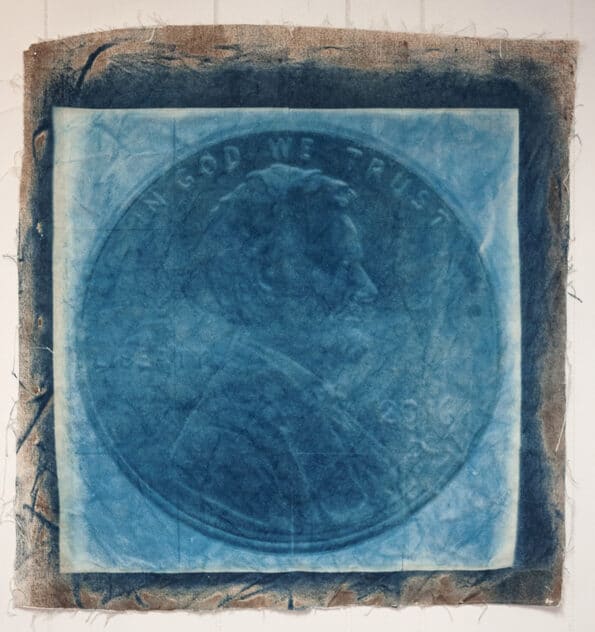
Title Loan, 2017

Title Loan, 2017
Cyanotype on canvas
variable sizes

Title Loan was made during the North Set Residency, a March–May 2017 residency organized by Bea Ying Projects in Houston. Three artists, Bradly Brown, Jessica Ninci, and Eden Rae, were given a vacant commercial building at 3411 Irvington Boulevard to use as studio space for several months. The building, renamed North Set Studios, had once been a title loan office. Work made during the residency was shown at the North Set Residency Closing Exhibition on April 28, 2017.

The series is a group of cyanotypes on canvas that reflect on the space they were made in. A title loan office sells the promise of a quick way forward, and the work considers the pursuit of the American Dream: how chasing it can feel like Sisyphus pushing a boulder up the hill, and how that pursuit is taken advantage of by people and businesses like short-term lenders.

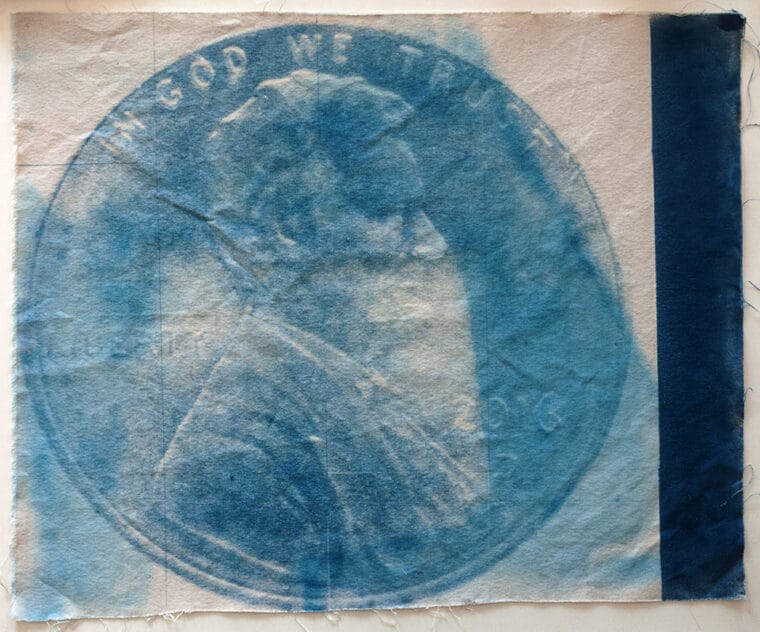
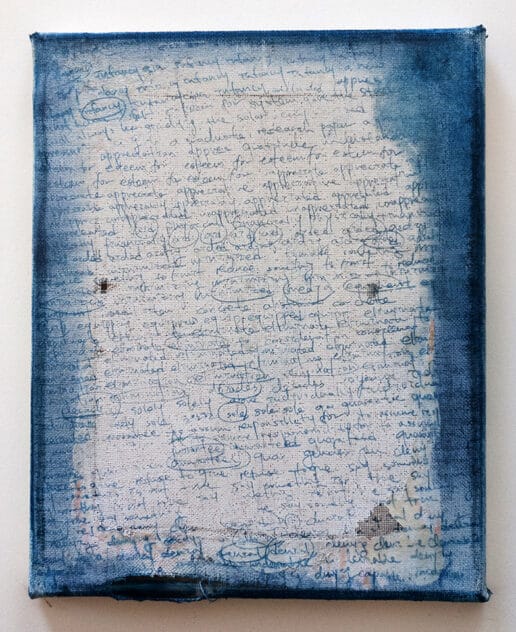
A large cyanotype of palm trees stands in for the idealized “paradise” at the end of that pursuit. Other prints are made from sheets of paper Brown pulled out of a trash can, left by someone, perhaps a student, who was learning English and had written the same words over and over as practice. The dense pages of repeated handwriting show the work and commitment it takes to chase a better life, even when that effort becomes obsessive and compulsive. Two giant cyanotype pennies on canvas offer Brown’s two cents on the pursuit of happiness and on those who profit from it.

A second series made at North Set, Spider Webs, extends the idea: the webs reference how title loan and other short-term lending companies can trap people in cycles of debt that are hard to escape. The found English-practice pages also appear in Brown’s earlier exhibitions Barnyard and Beastly Words.

The North Set Residency Zines, printed by The Center for Imaginative Cartography and Research, are available for purchase here.

Donkey Punch, 2008

Donkey Punch, 2008
Mixed media on chalkboard
48″ x 72″

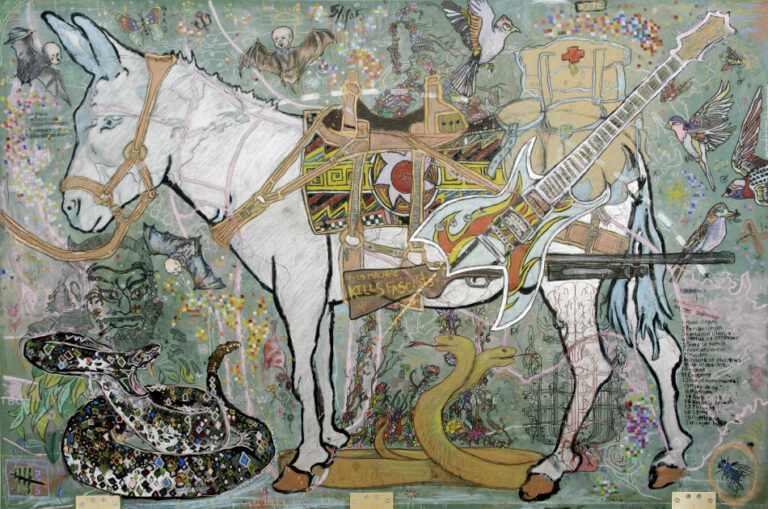
Donkey Punch is the album cover for Megafaun’s Bury the Square, released in 2008 on the experimental label Table of the Elements. Brown drew the image in mixed media on a chalkboard and then photographed it for the cover. He was also the art director and graphic designer for the release. Read the album’s review on Pitchfork.

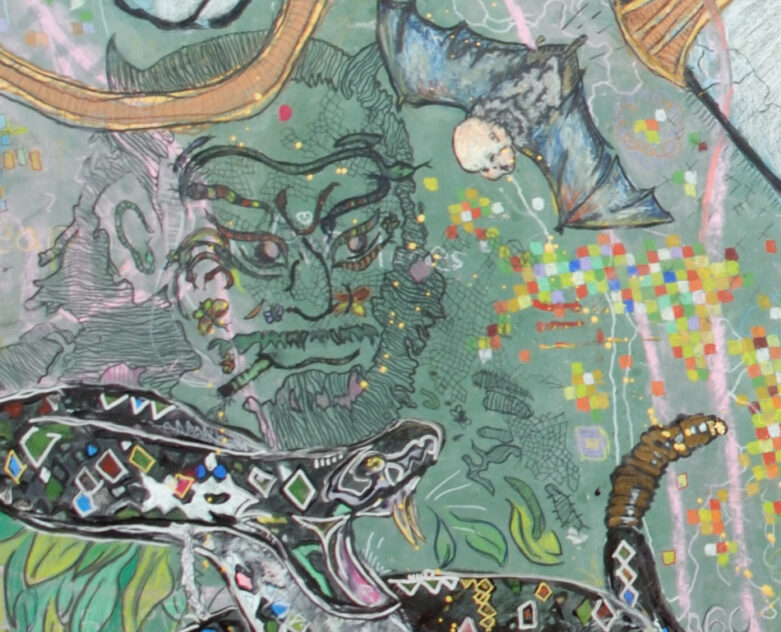
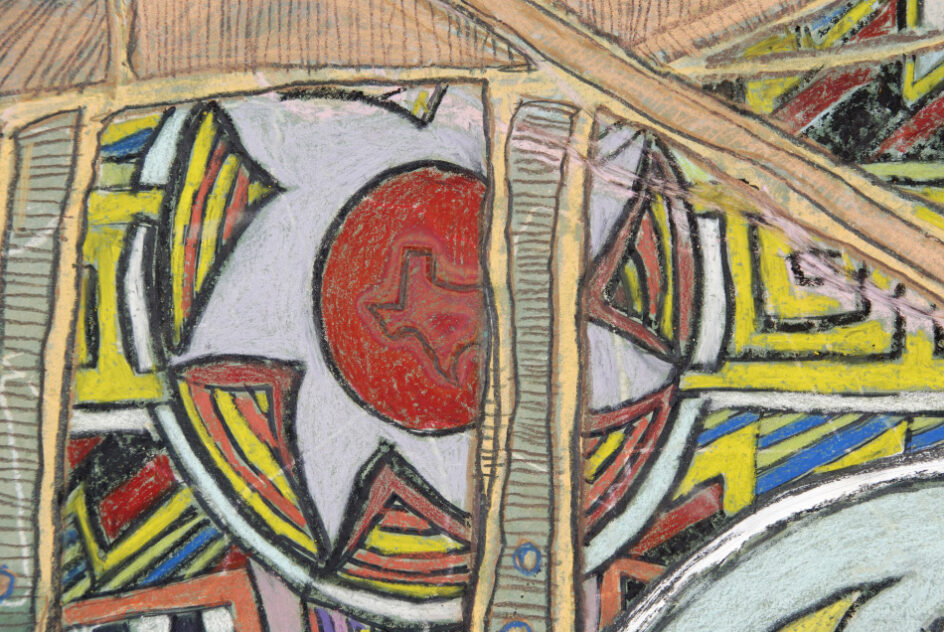
The drawing is an illustrated picture of the music industry and works as a cautionary tale about the life of a touring musician. The donkey stands in for the nomadic life of the road: a tour bus loaded with everything you own. Snakes, bats and con men surround it, figures that show one face but turn out to have two. The traveler keeps moving forward anyway and finds a way through them. The music itself is the real weapon, but sometimes it needs backup: help from those who build the path. That’s the shotgun, marked “This Machine Kills Fascists,” the slogan Woody Guthrie wrote on his guitar.

Donkey Punch was one of several projects Brown made through his design work for the label, where several albums came with their own creative project. See also Impala Eardrums and Side A.

Impala Eardrums

As Impala Murder, 2008
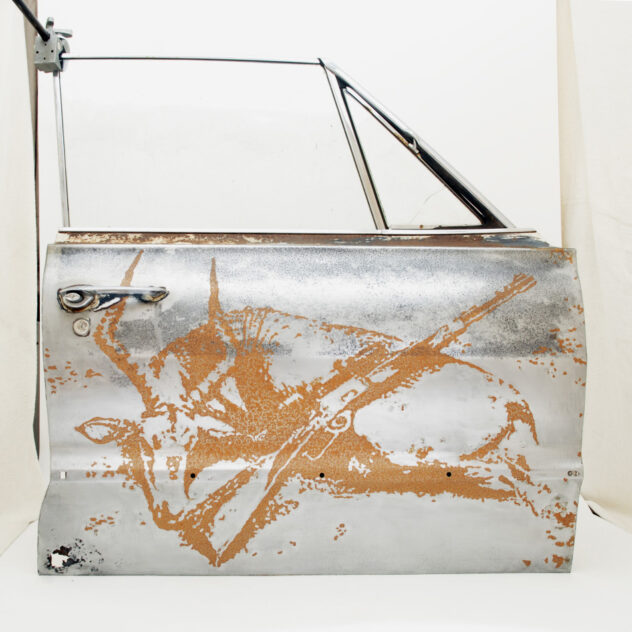
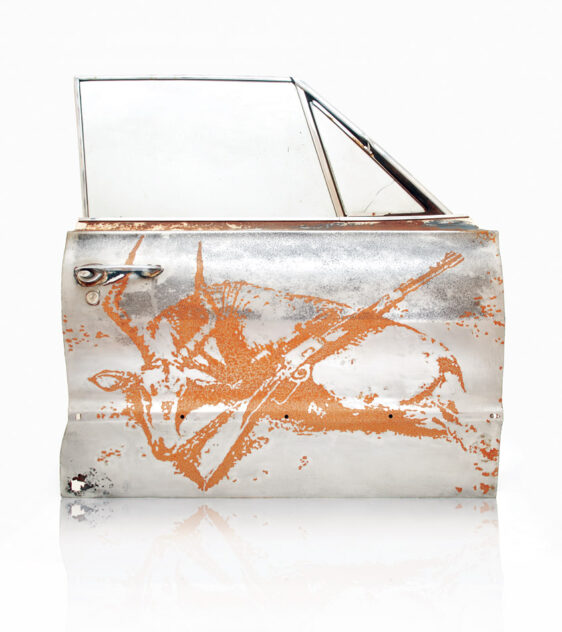
Salt water and hydrogen peroxide on car door
39.5″ x 37″

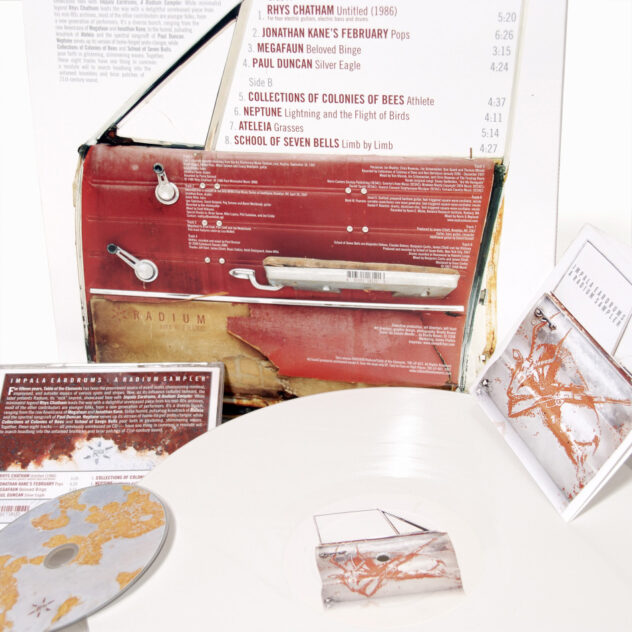
As Impala Murder is the cover art for Impala Eardrums: A Radium Sampler, a 2008 compilation from Table of the Elements’ Radium label. Both titles are anagrams of “A Radium Sampler.” Brown was also the art director, graphic designer and photographer for the release.

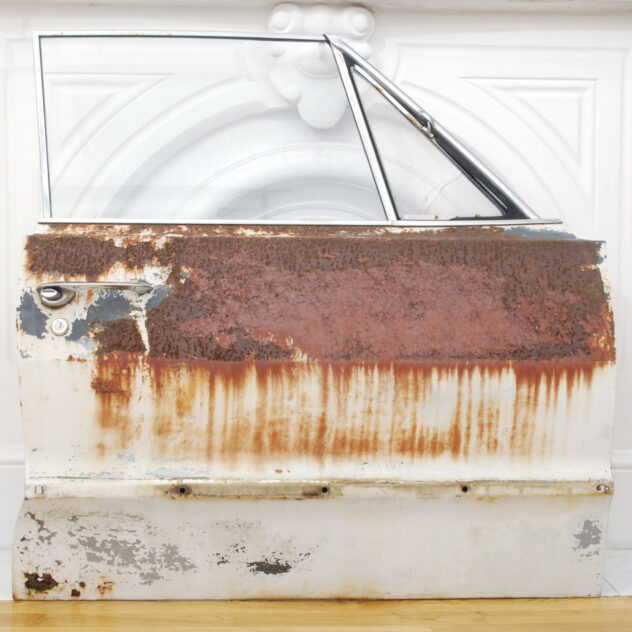
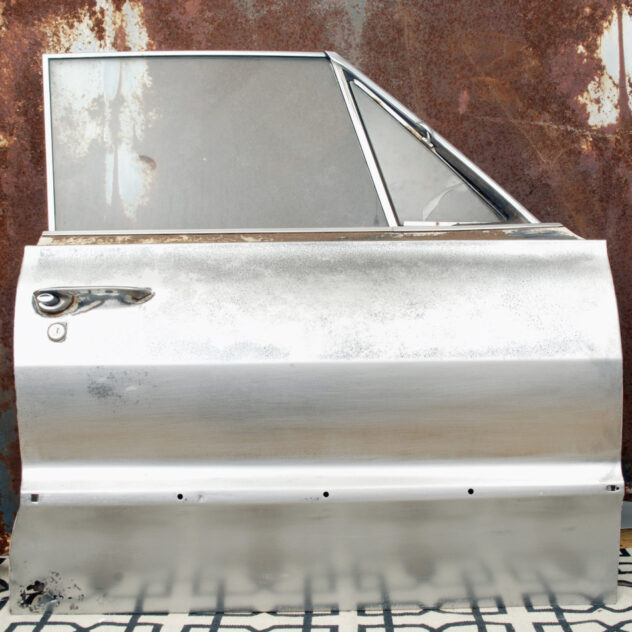
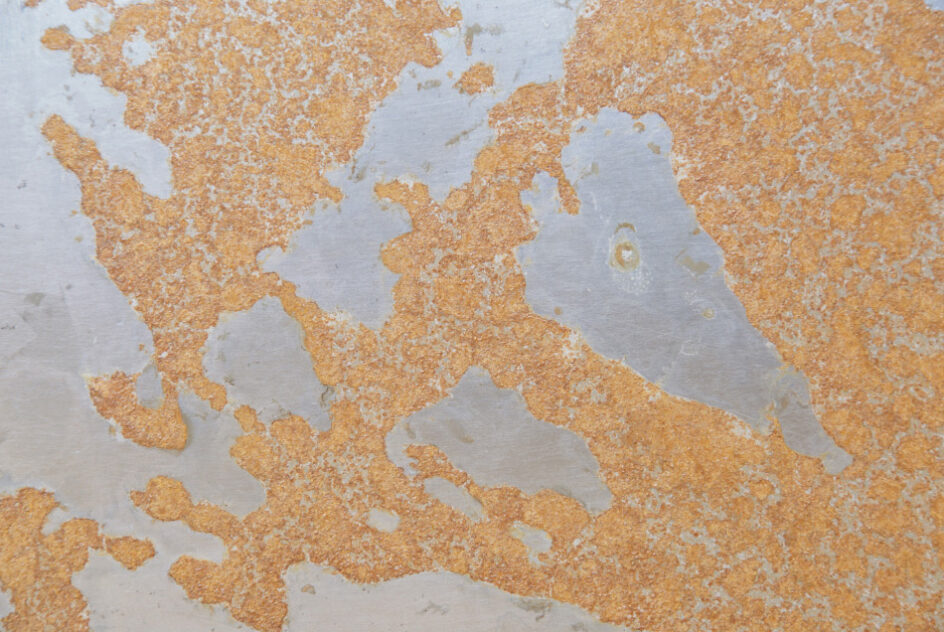
Brown found a Chevy Impala door in a Long Island junkyard and sanded it down to bare metal. He attached a stencil of a photograph to the door and sprayed it with a mix of salt water and hydrogen peroxide to cause it to rust. Once it dried, he removed the stencil, and the image was left behind formed in rust. Brown talks about the piece in this interview with KERA.

It was one of several projects Brown created through his graphic design work for the label, where several albums came with their own creative project. See also Donkey Punch and Side A.

Matchbooks, 2010

Matchbooks, 2010
Digital prints from film scans
Dimensions variable

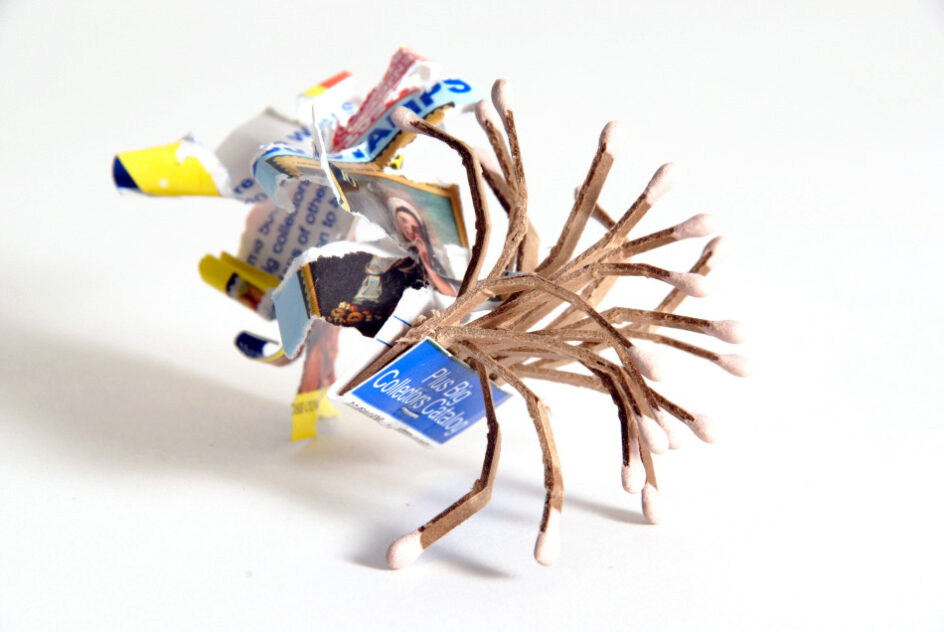
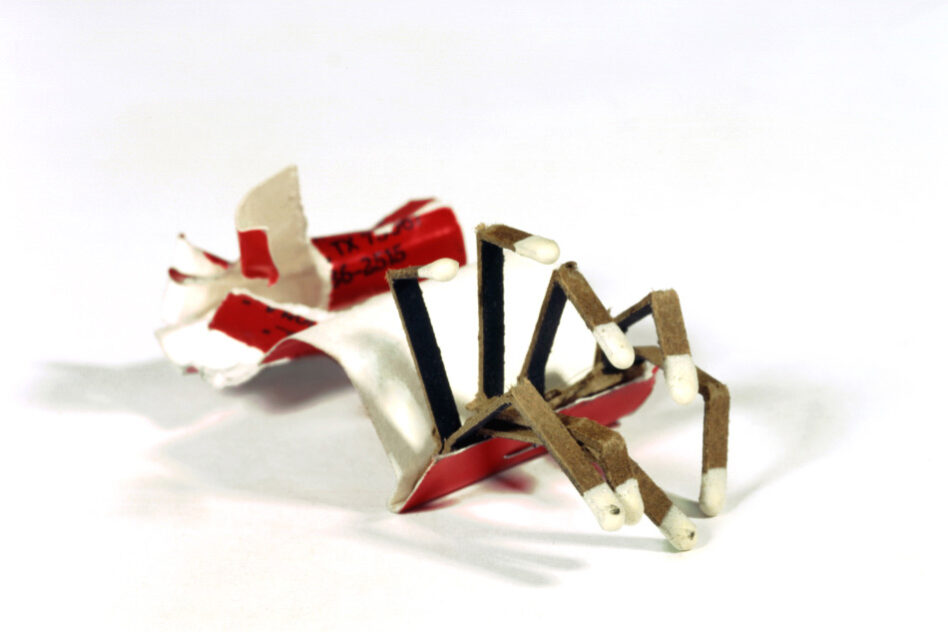
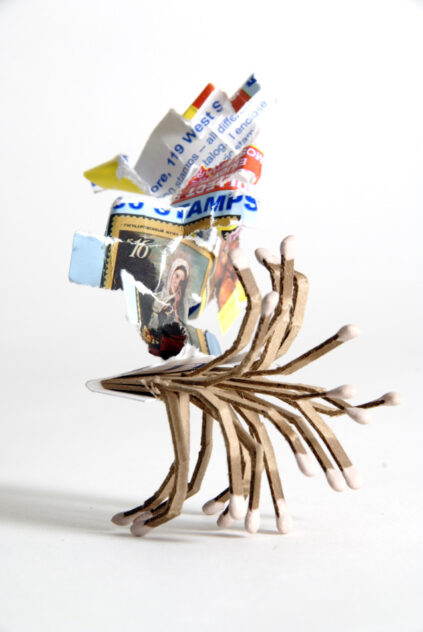
Matchbooks is a series of miniature sculptures made from ordinary paper matchbooks, photographed on film and printed at a large scale. Bent, folded, and torn, the matches and covers become small creatures with many legs, suggesting sea life, crustaceans, or insects. Enlarged in the photographs, objects that fit in the palm of a hand take on a gigantic, living presence.

The series is an exercise in taking a banal, everyday object and recontextualizing it as something whimsical or otherworldly. Like much of Brown’s work, it asks viewers to adjust their perspective and let go of their assumptions about what they are looking at.

The pieces also lend themselves to a formal reading of shape, form, color, and composition. Brown works with the graphics already printed on each matchbook, so every sculpture becomes a kind of three-dimensional collage, which the photograph then flattens back into two dimensions.

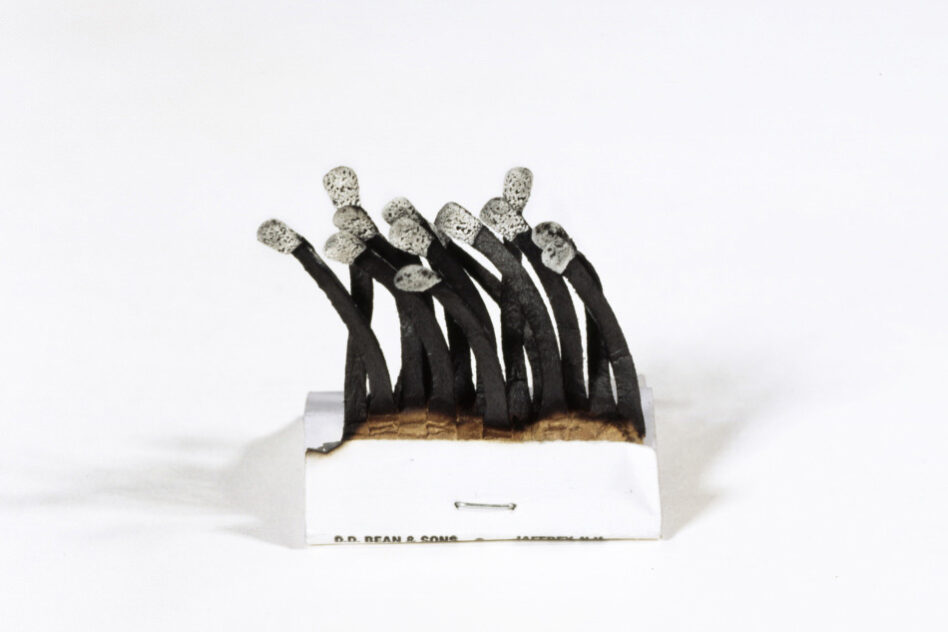
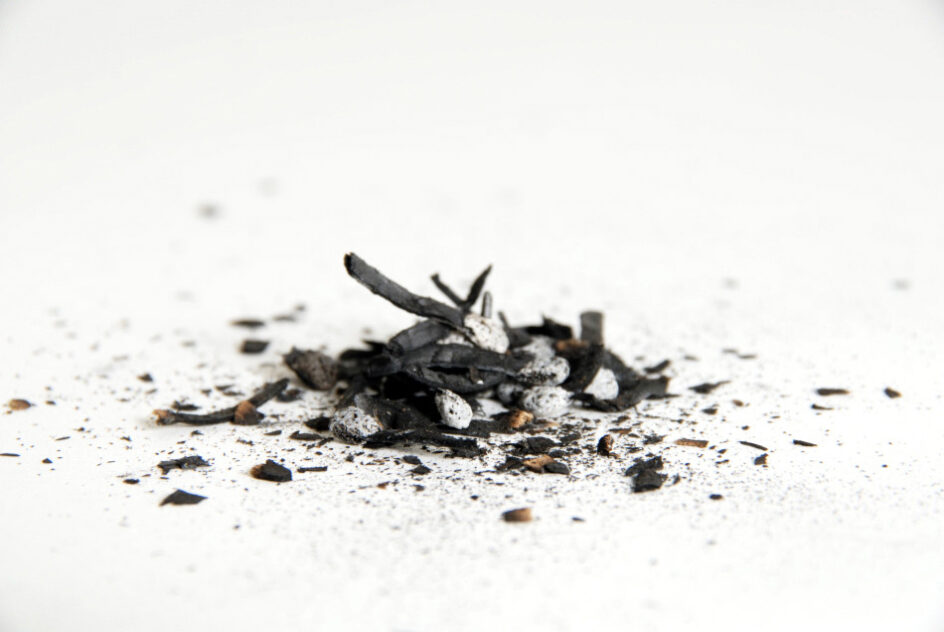
A related sequence follows the matches from material to application. Burned matches still standing in their matchbook read like a bouquet of flowers or long grass bending in the wind. The same burnt matches are then crushed into a pile of ash, and finally that ash is dragged across a page the way charcoal is used to make a drawing.

The sequence ties directly to Brown’s piece Several Ways to Start a Fire, which considers how the discovery and control of fire shaped human evolution and the development of art, writing, storytelling, and even language.

Drawing Stairs, 2016–present

Drawing Stairs (1-9), ongoing
Graphite / ink on paper

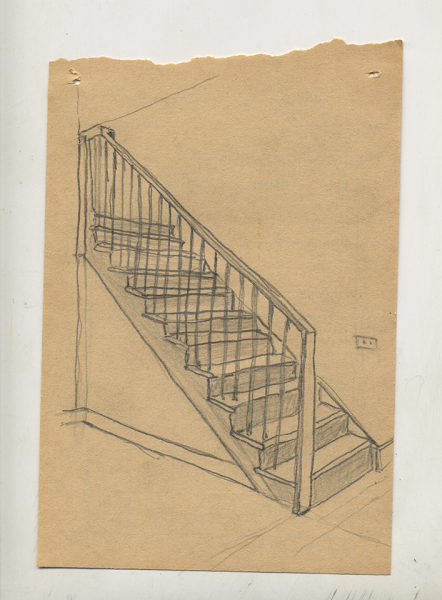
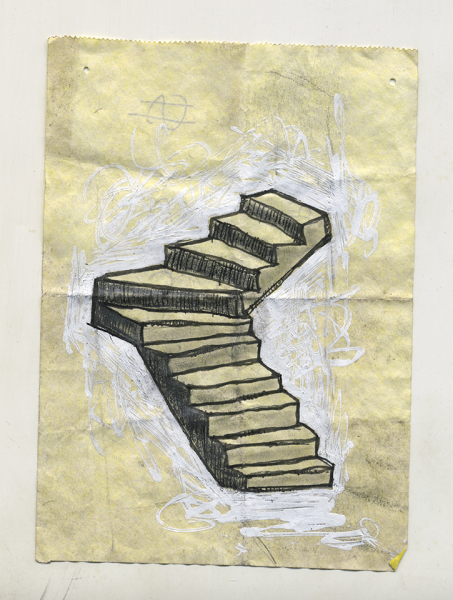
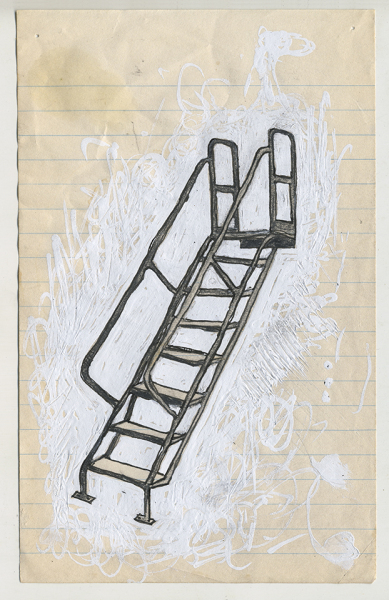
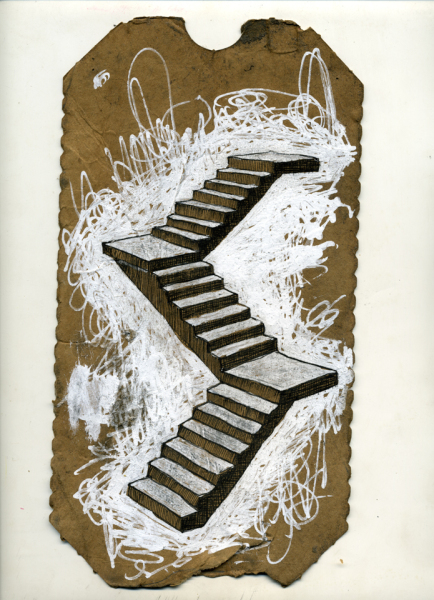
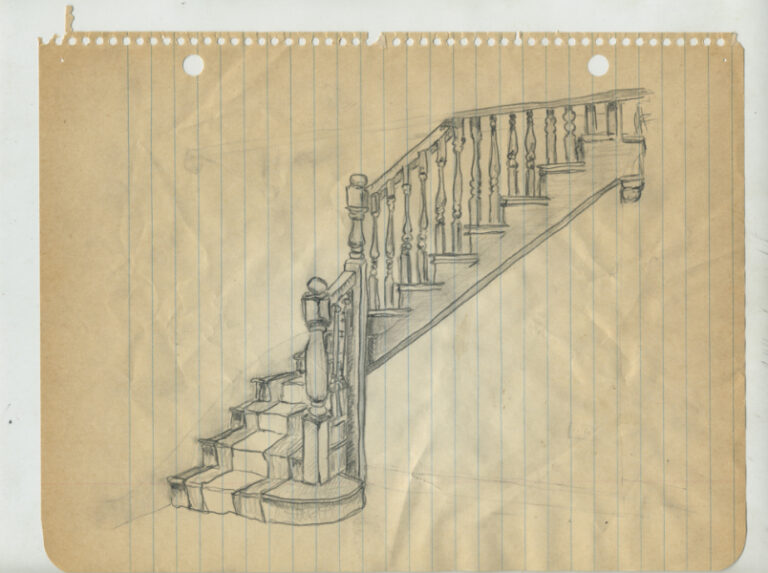
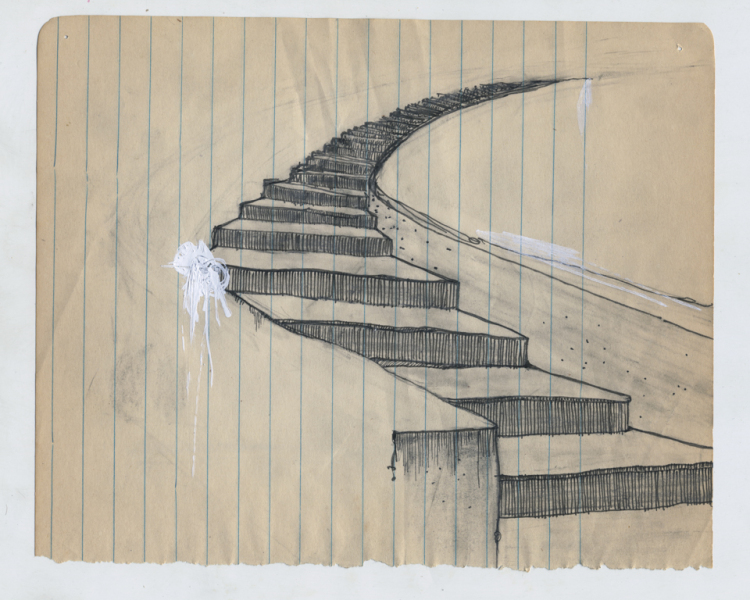
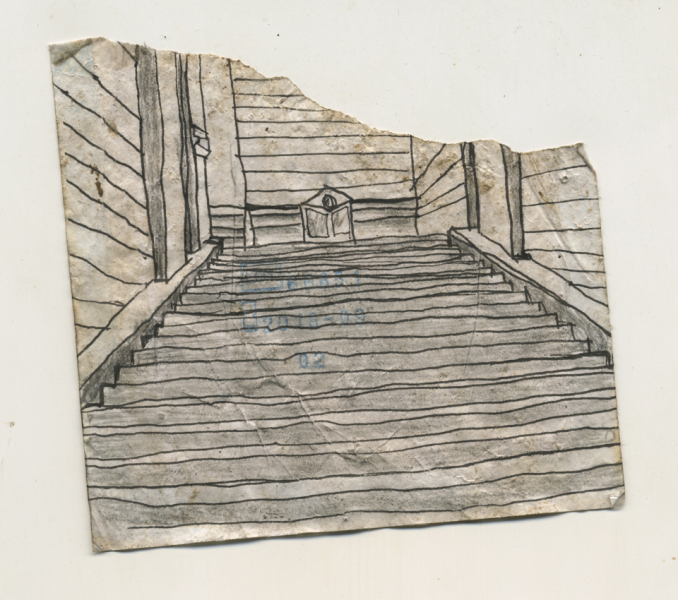
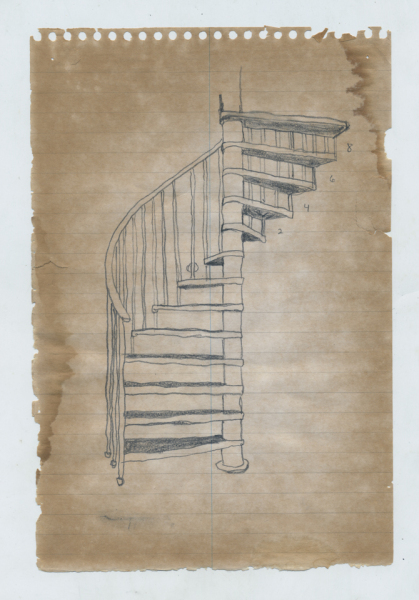
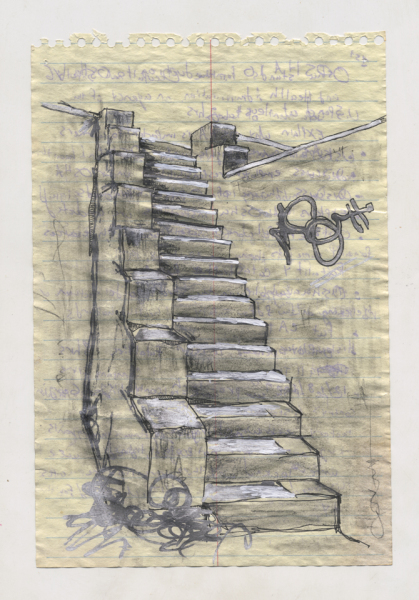
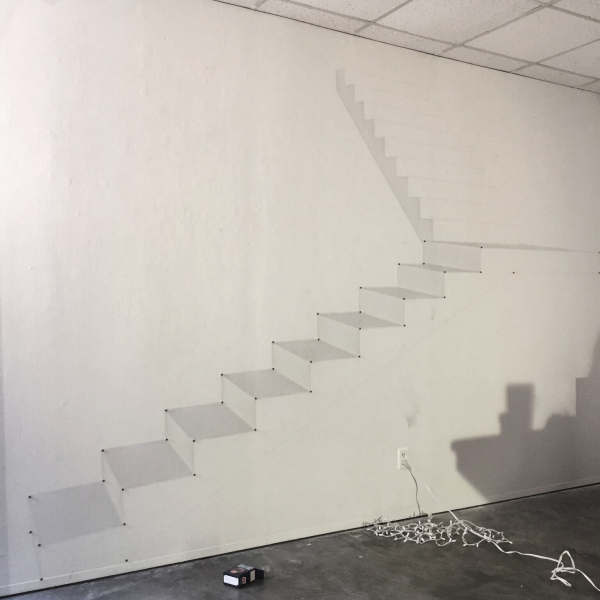
Drawing Stairs is an ongoing series built on a play on words. Brown seeks out staircases in public places and draws them on whatever paper he finds nearby: torn scraps, loose notebook pages, and abandoned notebooks picked up along the way. Each drawing is made on site, in graphite or ink, while Brown holds himself in an awkward physical position near the stairs for as long as the drawing takes.

Working this way in public turns the act of drawing into a kind of performance. People passing by slow down, stop, and stare as they try to work out what he is doing. The title names both halves of the work: Brown is literally drawing stairs, and at the same time drawing stares.

The found paper carries its own history into each piece, with ruled lines, spiral-binding holes, stains, and torn edges sitting alongside the drawn steps, railings, and landings.

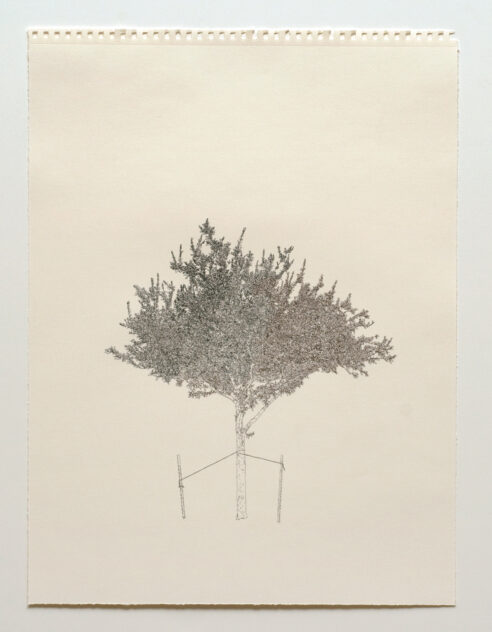
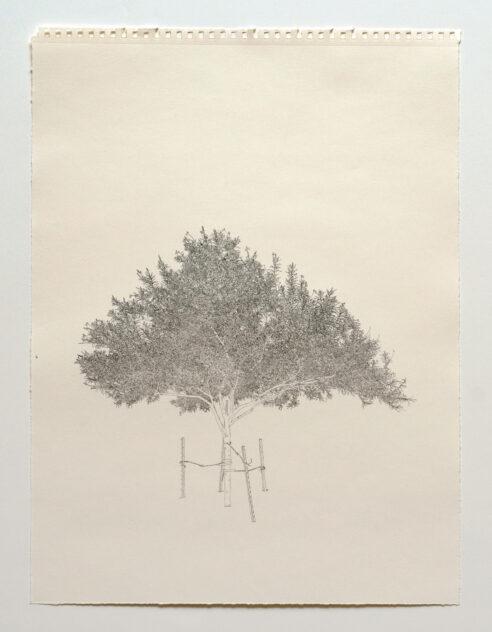
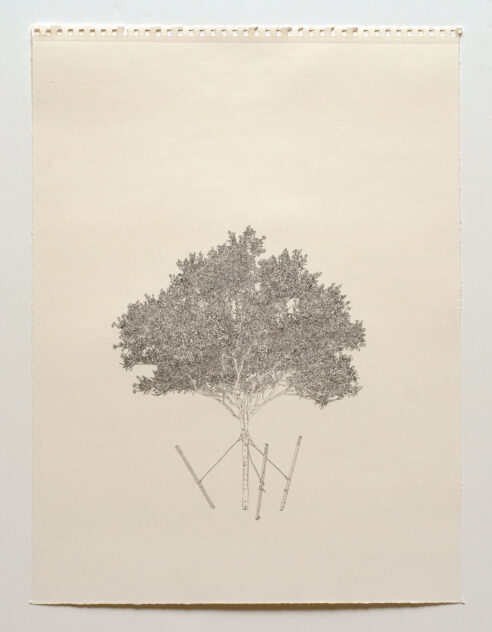
Three Trees, 2012

Three Trees, 2012
Unique digital prints
13″ x 17″

In Three Trees, the computer monitor becomes a camera lucida. Working from photographs, Brown redraws each tree by hand on screen, identifying every leaf while staying true to the original image.

The finished digital drawings are printed onto torn sketchbook paper. The ragged edges make each print a unique object, yet the image itself is infinitely reproducible. Like the cliché verre, the 19th-century process of printing hand-drawn glass plates on photographic paper, the work asks how an art object is valued: what is a physical print worth compared to the digital information that defines it?

The series is part of Brown’s ongoing fusion of drawing and painting with photography, a body of digitally crafted work that reevaluates tools and techniques from photographic history.

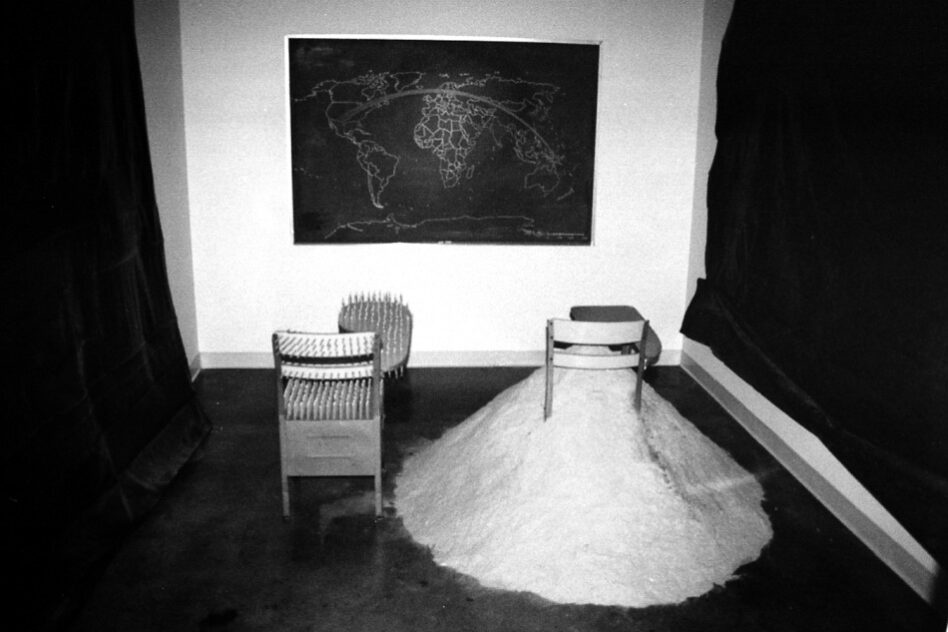
15,540 Miles, 2002

15,540 Miles, 2002
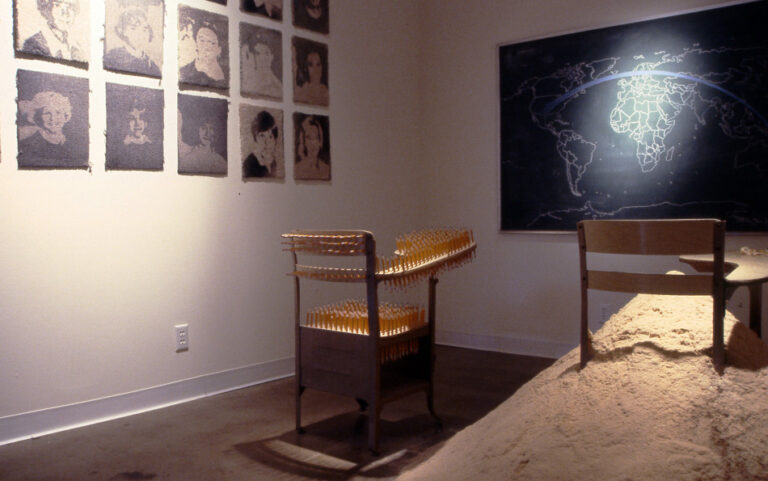
School desks, 444 No. 2 pencils, sawdust, pencil shavings, chalkboard, cyanotype on carpet
Variable dimensions

Exhibited at Conduit Gallery, Dallas, TX, 2002. This was Brown’s first commercial gallery exhibition.

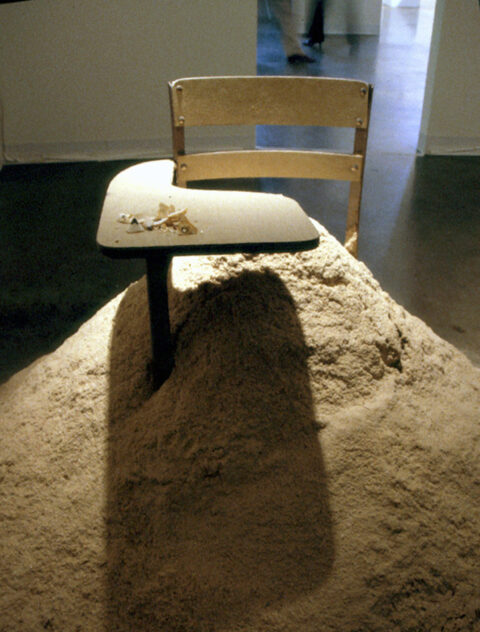
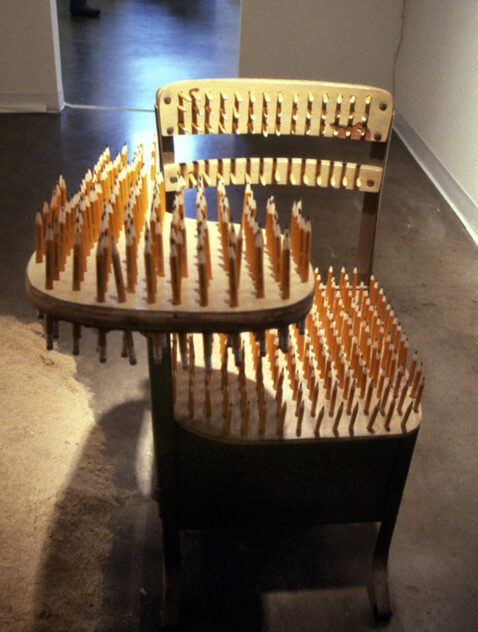
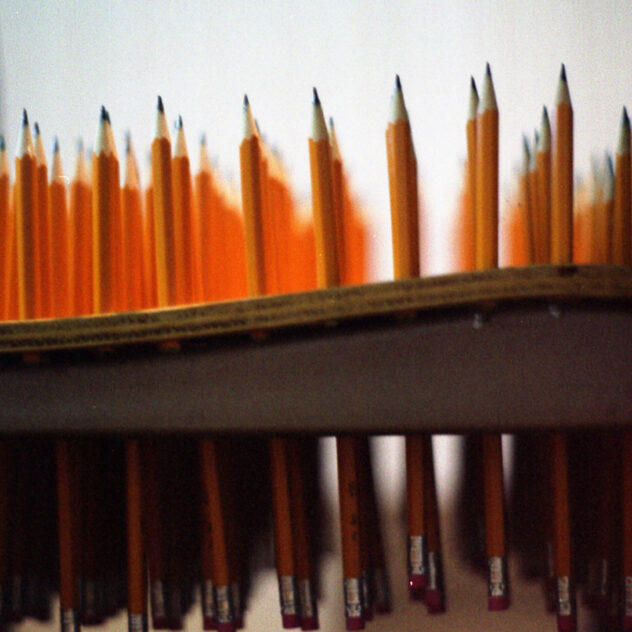
Two school desks sat in the middle of the room. One was embedded with 444 No. 2 pencils. A single No. 2 pencil can, in theory, draw a line about 35 miles long, so together the 444 pencils could draw a line 15,540 miles long. The second desk sat beside it, buried in sawdust and pencil shavings. On the wall facing the desks hung a classroom chalkboard with a world map drawn on it, and the 15,540-mile line was plotted across the map, starting in Dallas and heading east.

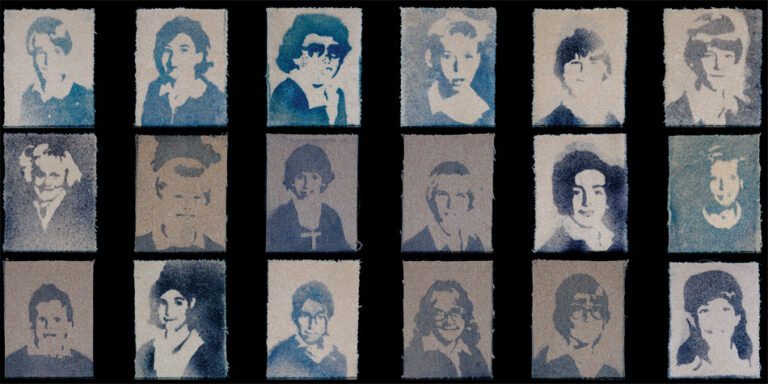
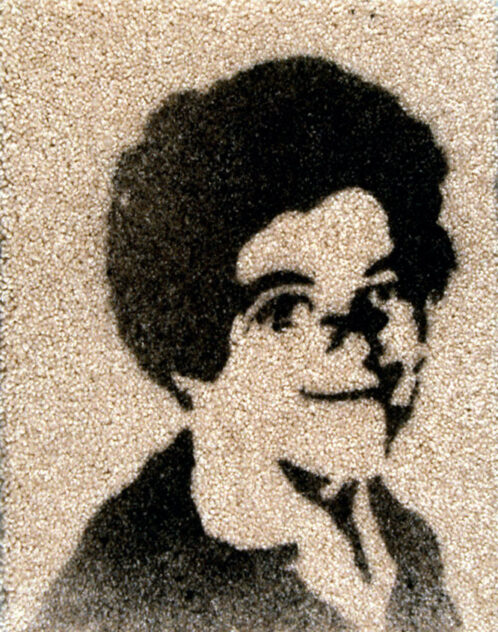
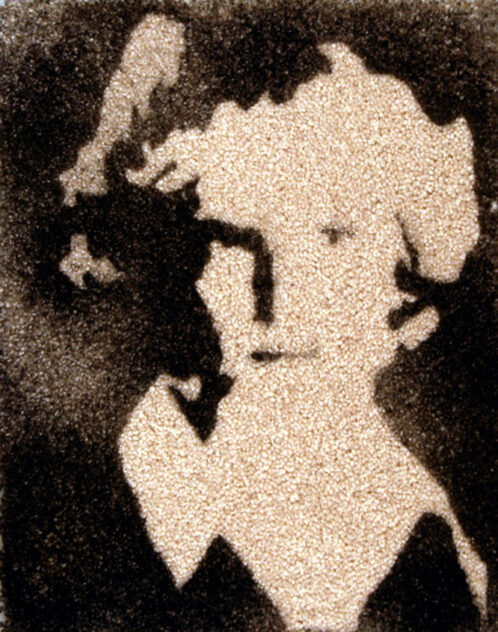
The walls to the left and right held 64 portraits, 32 on each side, of Brown’s classmates from his elementary school yearbooks. For each portrait he cut a stencil and sprayed cyanotype photo emulsion onto a piece of carpet. The portraits were hung unexposed and kept under a black tarp until the opening reception. That night the tarp came off, and over the course of the evening the faces slowly appeared on the carpet as the emulsion reacted to the light.

The installation is about fear and pressure and the two ways people respond to them. Fear can push you to move, or its weight can hold you in place. Some people adapt and excel; others get buried.

HOMECOMING! COMMITTEE

The Texas-based art collective HOMECOMING! Committee was founded to create initiatives and spaces where artists, designers, and creative thinkers could collaborate as equals, engaging in a shared practice of artistic agency. Through interactive and participatory events, HOMECOMING! fostered an environment that empowered artists to take action, build networks, and pursue future collaborations.This fortification of creative resources repositioned the artist as an individual that shapes cultural discourse, rather than a member of society that merely reacts to it.

For More Information about HOMECOMING! Committee, please visit www.themodern.org/podcast/

SELECTED HOMECOMING! EVENTS:


PRESS:

Selected press, reviews, and recognition for HOMECOMING! Committee, 2011–2014, and later coverage of the collective’s work.

Recognition

Articles & Features

Audio & Video

semigloss. MAGAZINE

(Please visit www.semiglossmag.com for more information)

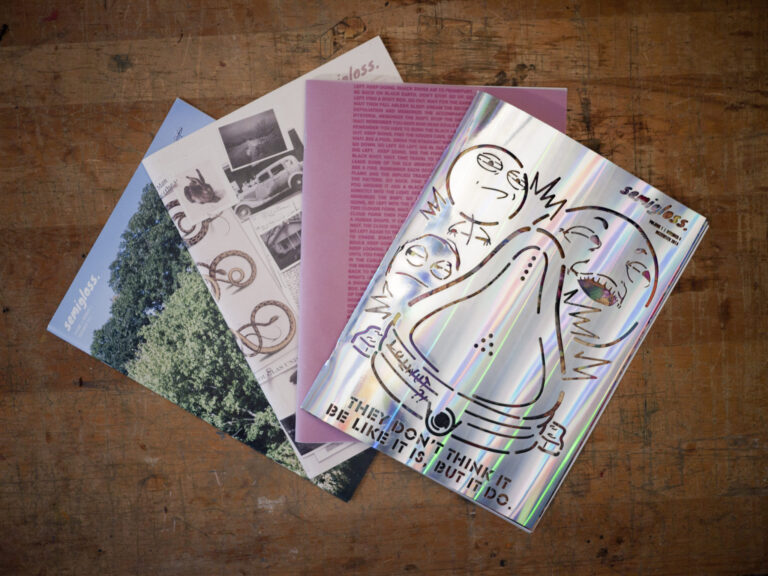
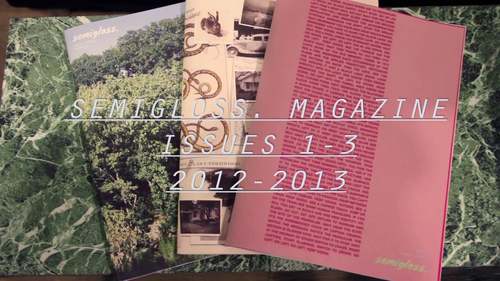
semigloss. Magazine was a Texas-based arts publication founded by Sally Glass and Bradly Brown in 2012. The magazine highlighted international artists and writers and produced content that ranged from editorial and theoretical essays to interactive installations and vinyl records. Each issue focused on a certain concept or theme within the context of contemporary art thought and practice. Published from 2012 to 2016, semigloss was intended to operate as a physical archive of the artistic idea but quickly expanded beyond the publication.

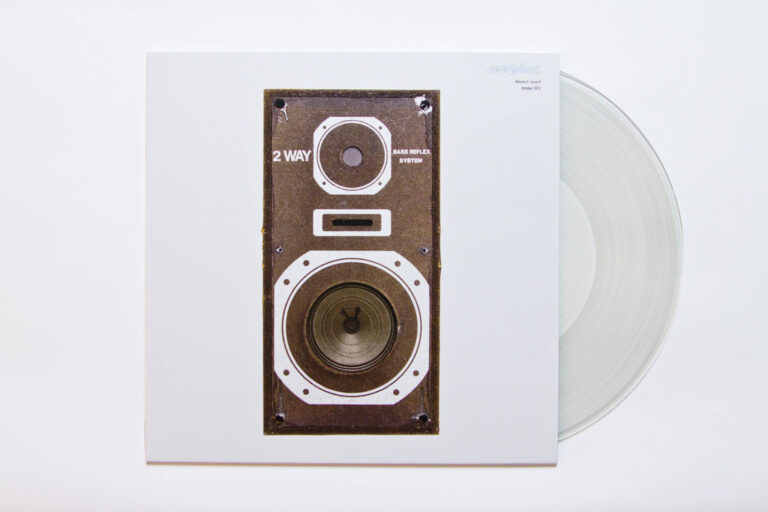
In 2016, the last issue, “Sound”, was released as a vinyl record with a corresponding immersive installation at the Contemporary Arts Museum of Houston, the Nasher Sculpture Center in Dallas, and B4BEL4B in Oakland, as well as a listening event at the James Turrell Twilight Epiphany Skyspace at Rice University.

About semigloss. Magazine

semigloss. Magazine was conceived as an exhibition in print. The idea grew out of conversations at Radical Regionalism, a panel on North Texas art held at CentralTrak in Dallas, and from its first issue the magazine treated each edition as a themed exhibition that complemented the others. Issues combined constructed images, critical and theoretical essays, artist projects, sculptural inserts, and vinyl records, putting artists and writers from North Texas in conversation with an international group of contributors.

Founding editor-in-chief Sally Glass and co-founder and art director Bradly Brown produced six issues across two volumes between 2012 and 2016: PLACE, EPHEMERA, FAILURE, FUTURE, DB14 (a collaboration with the 2014 Dallas Biennial), and SOUND. Contributors included Kenneth Goldsmith, Adrian Piper, Brad Troemel, Morehshin Allahyari, Kim Asendorf, Asger Carlsen, Tom Lawson, Noah Simblist, Christina Rees, Lucia Simek, Margaret Meehan, Stephen Lapthisophon, Jesse Morgan Barnett, and Michael Mazurek.

The Issues

Partners and Venues

Over its run, semigloss. worked with CentralTrak, the Nasher Sculpture Center, the Goss-Michael Foundation, The Reading Room, Fort Worth Contemporary Arts, the Texas Theatre, Conduit Gallery, Oliver Francis Gallery, Oil and Cotton, McKinney Avenue Contemporary, David Shelton Gallery, That That, the Contemporary Arts Museum Houston, the Menil Collection, James Turrell’s Twilight Epiphany Skyspace at Rice University, B4BEL4B in Oakland, and Printed Matter in New York, and appeared at art book and print fairs in the US and abroad.